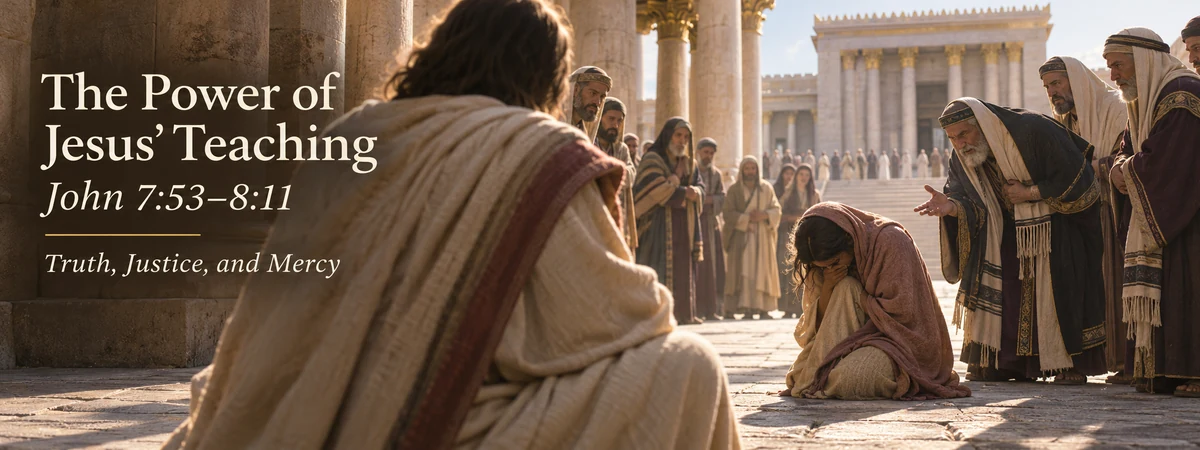
The Power of Jesus’ Teaching: Truth, Justice, and Mercy
John 7:53–8:11 — The Bible Teaching Commentary
Scripture: John 7:53–8:11
7:53 And every man went unto his own house. 8:1 Jesus went unto the mount of Olives. 2 And early in the morning he came again into the temple, and all the people came unto him; and he sat down, and taught them. 3 And the scribes and Pharisees brought unto him a woman taken in adultery; and when they had set her in the midst, 4 They say unto him, Master, this woman was taken in adultery, in the very act. 5 Now Moses in the law commanded us, that such should be stoned: but what sayest thou? 6 This they said, tempting him, that they might have to accuse him. But Jesus stooped down, and with his finger wrote on the ground, as though he heard them not. 7 So when they continued asking him, he lifted up himself, and said unto them, He that is without sin among you, let him first cast a stone at her. 8 And again he stooped down, and wrote on the ground. 9 And they which heard it, being convicted by their own conscience, went out one by one, beginning at the eldest, even unto the last: and Jesus was left alone, and the woman standing in the midst. 10 When Jesus had lifted up himself, and saw none but the woman, he said unto her, Woman, where are those thine accusers? hath no man condemned thee? 11 She said, No man, Lord. And Jesus said unto her, Neither do I condemn thee: go, and sin no more.
— King James Version (KJV)
This passage is absent from the earliest Greek manuscripts, and some later manuscripts place it elsewhere. Its original placement in John is therefore uncertain. Yet the account is consistent with Jesus’ purpose and life, and illustrates His powerful mercy.
Many assume that success proves the effectiveness of their techniques. We admire Jesus for His ability to attract a good crowd. We need to be more concerned with how He used the truth to penetrate those people’s hearts and minds. This passage gives us a beautiful model through which we can better understand the power of Jesus’ teaching.
A. Preparation for Sharing Truth (John 7:53–8:1)
The Mount of Olives stands as a symbol of dedicated prayer. Prayer is work and probably one of the most important ministries possible. Jesus went to the Mount of Olives while others went home. He may well have spent time there in prayer.
Today's Christian world seems to parade the success of certain pastors, teachers, and churches. Everything about their means and plans for success is carefully scrutinized, except their dedication to prayer. Perhaps prayer is thought to be more spiritual and therefore private, not discussed. Unfortunately, we often let people assume we pray more than we do. To protect this misconception of ourselves and not expose others, we don’t often discuss prayer time.
Although John does not tell us how Jesus spent the night, His example of dedicated prayer elsewhere in the Gospels challenges our superficiality and exposes the cause of our lack of faith. The simple point is that Jesus, the Son of God, needed and desired to pray, even at the cost of sleep (Luke 6:12). Both the Korean and Argentine churches demonstrate how God can mightily work through these long times of prayer. Prayer is essential not only in form but also for vitality, clarity, and power. If Jesus, the Son of God, so prayed, we, the church, must also so pray lest we fall to temptation and miss out on what the Lord wants to do through us. “With all prayer and petition pray at all times in the Spirit” (Eph. 6:18, NASB 1995).
B. The Presentation of Truth (John 8:2)
We shouldn't take Jesus’ teaching ministry for granted. He was up and out early in the morning. Jesus may have first worshiped at the temple. As people streamed along with their lost-looking faces, He saw their needs and responded with teaching.
Some people think the Sunday sermon can and should be shortened. If there is not much of God's Word in it, shorten it. But people really need to hear the truth. God's Word attracts people. Truth somehow enables people to see inside themselves. Some might call it a form of psychiatry with direction. This seems a very limited view of what God does through His Word. People need God's help to deal with their problems.
The teacher has to:
- meet the Lord in concentrated prayer (v. 1).
- worship the true God regularly yet spontaneously.
- closely associate with the truth so that people will seek an opportunity to learn from the teacher.
- teach the people.
C. The Ministry of Truth (John 8:3–11)
The Dilemma (8:3–6a)
As far as most of us are concerned, the scribes and Pharisees set up an almost impossible situation from which God's truth could minister. This was, in fact, what the Jewish leaders wanted. They were not concerned with real justice, for otherwise they would also have brought the man with whom she committed adultery. They ostentatiously upheld the Old Testament law, and so if Jesus wasn't careful, He would have been accused of not upholding the law. Perhaps it was the very merciful and tender ministry of Jesus that convinced the Jewish leaders that Jesus would not be able to reconcile His ministry of mercy with the straightforwardness and harshness of the law. Whether Jesus supported the condemnation of the adulterous woman or let her go “free”, the truth would not look attractive. They did not want to know the truth but to use it to trap Jesus. Jesus was more concerned with their ruthless treatment of the woman than with the question itself. Jesus used God's Word as a sword to straighten out the whole situation. The truth never needs to be defended but only properly presented.
Jesus was courageous. He thought about the needs of others and yet always wanted the truth to be accurately presented.
Jesus’ Response (8:6b–11)
Jesus had to deal with two very different situations.
1. The self-righteous accusers
He first dealt with the self-righteous accusers. They were demanding the law's execution against this sinner. Jesus perceptively saw that they were unfit to be judges of any sort because they were equally wicked. Some have suggested that Jesus wrote either the Ten Commandments or their particular sins on the ground, but the passage does not tell us what He wrote. The law had force of its own; like setting a hound on a chase, Jesus set the law loose. He did this by letting the law destroy their self-righteous egos. They dealt with her as if they had no sin, but as they started to walk away from the scene, they admitted they too had sinned. If they condemned her, they should also be condemned. They did not want to expose themselves in their attempt to expose Jesus! Jesus used the law rightly. He both exposed sin and properly presented the truth of the law.
2. The woman’s sin
Jesus still needed to deal with the woman's sin. His opponents all scattered. They would condemn themselves if they condemned her. But the tension remained. How would He deal with this woman? Her accusers left, but the law remained, demanding justice. He could not put mercy in opposition to the demand of God's justice. The sin was committed.
Jesus’ statement, “Neither do I condemn you” (John 8:11, NASB 1995) is very significant. For one, it showed the world that Christ was on a mission of redemption rather than judgment (John 3:17). Even more significant is His subtle claim not to condemn. The others couldn't condemn, but Jesus decided not to judge the woman. He, as a righteous Israelite, could have thrown that stone to uphold the law. But Jesus, as the Son of God, was saying something far more significant. His refusal to judge was a pardon. Jesus didn't condone the sin; she was not to do it anymore. But because all judgment was in His hands, His refusal meant pardon.
Theologically speaking, we might be troubled by this refusal of the Judge to judge (John 5:27). However, we only need to think of the provision of pardon supplied in the sacrifice of the Son of God. When Jesus said He didn't condemn her, He was also saying that He would die on the cross for that very same sin she committed. God’s mercy does not bypass the demands of His justice. Jesus’ mercy was evident in His coming to save us at all. We have pardon and the plea of mercy in this world only because we have human standards, human laws, human understanding of true events, and human executors. We need to be merciful because we make mistakes and have prejudices. Christ received all authority to judge and willingly took upon Himself the sins of sinners. It was this sin and many others that drove Christ into a miserable and undeserving early death. Every promise of forgiveness to sinners is backed by the shedding of His blood.
Conclusion
In conclusion, we find the scribes and Pharisees trying to confound Jesus by pitting His loyalty to kindness toward sinners against His loyalty to the Law. Jesus Christ's response came in two ways: 1) human handling of the law is totally inadequate because they are sinners, and 2) Christ's dealing with this situation was both that of a righteous man, who could pick up the stone and satisfy justice, and that of the Christ, who could satisfy the judgment due her by giving up His own life.
I am forgiven only because Christ was willing to die for my own sin.