
Hebrews 4 Study • Part 2 of 2
Entering God’s Rest: The Message of Hebrews 4
Persevering in Faith and Finishing Well
Paul J. Bucknell
This is Part 2 of a two-part study. Part 1 considers how theological assumptions can become interpretive filters. Read Part 1: The Correct Interpretation of Hebrews 4 »
Hebrews 4 in a New Light
What led me to understand Hebrews 4 in a different light? I must say it was God’s graciousness in instructing a slow learner. I’ve learned that when I encounter a verse I don’t fully grasp, I ask Him for wisdom and entrust Him to teach me at the right time. (I have many more discoveries to come!) In this case, my through-the-Bible-in-a-year reading again brought me to chapter 4 of Hebrews. Perhaps I was mesmerized by the repeated call to constancy in one’s faith. I’m getting older, and I have several older brothers with whom we mutually challenge each other to remain faithful to the end.
This theme in Hebrews, especially as expressed in Hebrews 4, helped me focus on what I now consider the proper interpretive grid: the need for saints to persevere to the end and not step aside under pressure from others or out of fear. The Book of Hebrews is commonly understood in light of its strong Jewish readership, as evidenced by its numerous references to and allusions to the Old Testament. It is primarily written to Jews who have come to know Christ but now face threats and pressure from the old Jewish guard, who tell them they have left the Jewish faith and God Himself.
I’m now older and have been focusing on the need to persevere to the end of my life, whether it be one or twenty years remaining. I don’t want to be like others in the Old Testament who left following the Lord because of their success, being allured, or pressures from those around them. This mindset has repeatedly come to mind as I read through 1 & 2 Kings and Hebrews.
Basic Interpretation of Hebrews 4
When Hebrews speaks of rest, it is not referring to Exodus 20 and the Ten Commandments about keeping the Sabbath. Instead, the author refers to the earlier God-and-creation passage (Genesis 2:1–3). God worked six days and then entered His rest (rest and sabbath being the same). I, as a believer, am exhorted to work hard at the works He has prepared for me right to the end—then the rest comes. This is the intended interpretation, which I’ll show below. The author is concerned with persevering in faith, not explaining how to gain salvation. (I am avoiding the topic of losing salvation to stay focused. That is another full topic worth exploring that often comes up in this book.) We all, whether or not we think we can lose salvation, are to adopt a mindset that goes deeper: Persist in believing. By believing, we will live our lives to please God, even in the face of persecution. We find unity in our need to persevere, a theme emphasized in chapter 4 and throughout Hebrews.
With a straightforward understanding, uncluttered by theological concepts, I came to the passage better able to discern the author’s intent. What I share is not a novel interpretation; it is commonly repeated and fully in harmony with the chapter and the book.
General Interpretation of Hebrews 3 and 4
I’ll now briefly discuss Hebrews 3 and 4, showing the numerous instructions that harmonize with this charge to persevere in the faith, while highlighting specifically mentioned topics like Joshua.
Hebrews 3
Hebrews 3 has already introduced the theme of rest, rebuking the Israelites’ unbelief in the wilderness after the Exodus: “As I swore in My wrath, ‘They shall not enter My rest.’” In other words, perseverance in faith is essential to our future hope and reward. The same holds true for Moses and Jesus, who is presented as the greater Deliverer.
- Moses led the Israelites out of Egypt and through the Wilderness to the edge of the Promised Land. Afterward, Joshua, under the Old Covenant (Heb 3:4–19), brought them into the Promised Land. But they responded without faith in God, as shown through their idolatry.
- Jesus likewise used miracles and suffering to lead His people into eternal life and fully delivered them through the New Covenant (Heb 2:14–3:6) established by His own shed blood.
Chapter 3 ends by taking up this theme and developing it further in chapter 4.
3:18 And to whom did He swear that they would not enter His rest, but to those who were disobedient? 19 So we see that they were not able to enter because of unbelief.
“Therefore”: Hebrews 4:1–3
The “therefore” in verse 4:1 shows that the chapter division is poorly chosen. Rest in the Mosaic age signifies finding security in the Promised Land—their own land—but they did not combine it with faith. That rest in the Promised Land was lost because of their lack of faith.
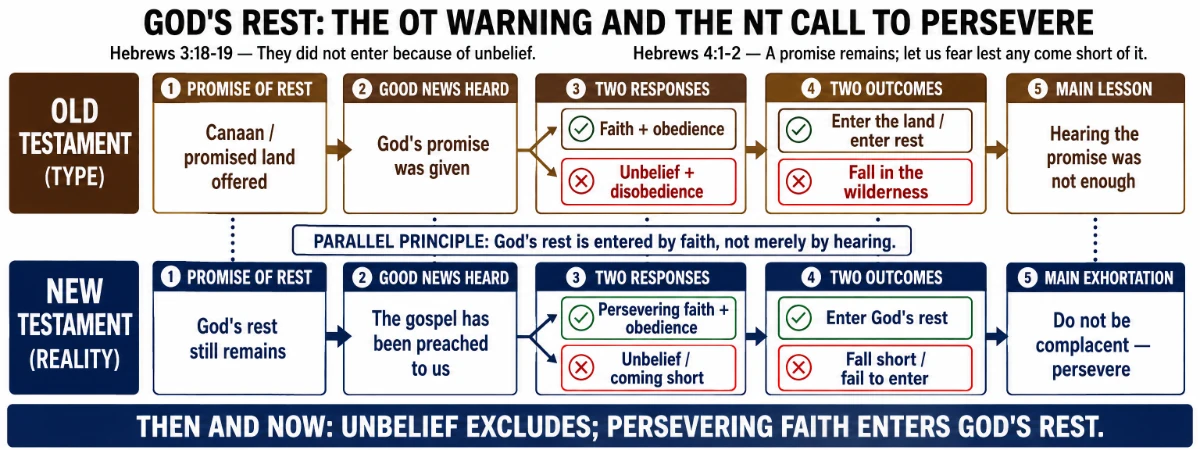
Rest in the New Testament age likewise depends on faith for salvation in Christ. The author highlights their parallel situation to drive home this teaching in chapter 4 for those professing believers who are wavering in their faith.
4:1 Therefore, let us fear if, while a promise remains of entering His rest, any one of you may seem to have come short of it. 2 For indeed we have had good news preached to us.
The theme of persevering faith continues into chapter 4, as seen in verse 1’s “a promise remains of entering His rest” and the inclusion of the believers in Christ to whom “good news was preached.” The author equally points out the same temptation to downplay the importance of salvation and give it up, in contrast to persisting in one’s faith after deliverance. We would be foolish to reject our faith and suffer as the past Jews who died in the wilderness because of their unbelief. He continues in verse 4, speaking about God’s rest before turning to Joshua’s rest.
God’s Rest: Hebrews 4:4
4 For He has said somewhere concerning the seventh day: “And God rested on the seventh day from all His works”; 5 and again in this passage, “They shall not enter My rest.” (NASB)
Starting in verse 4, he grounds his argument in a solid foundation—God’s own rest. God worked for six days, then rested. All know and accept this fundamental design of creation. By faith, we also do the works God has for us and later enter His promised rest. Some confuse the works here with the works needed for salvation, but that would be wrong.
Genesis is obviously not speaking of man’s salvation, much less of God’s, but of His rest. And so, we should not think that this rest describes our reconciliation with God, but rather the end of our lives, the eternal age with God. If we love God, we should follow His pattern: work → rest. This orientation helps us rightly interpret “works” not as activities for entering salvation—we are already at peace with God—but as those that result from it. We, like God, use our faith to practice good works before entering our eternal rest. He quickly moves on to Joshua, which confirms the correctness of our interpretation.
Joshua’s Rest: Hebrews 4:8–11
8 For if Joshua had given them rest, He would not have spoken of another day after that. 9 So there remains a Sabbath rest for the people of God. 10 For the one who has entered His rest has himself also rested from his works, as God did from His. 11 Therefore let us be diligent to enter that rest, so that no one will fall, through following the same example of disobedience.
Joshua’s text follows the pattern set in Genesis chapter one. Joshua did not lead them to the final rest. There are several possibilities for the author’s basis for stating that “Joshua had (not) given the rest.” “He speaks of another day.” What does this refer to? Back to one of the rests in verse 3, or to God’s rest in verse 4? Verse 5’s rest probably points back to verse 3, though I will introduce it without defending it.
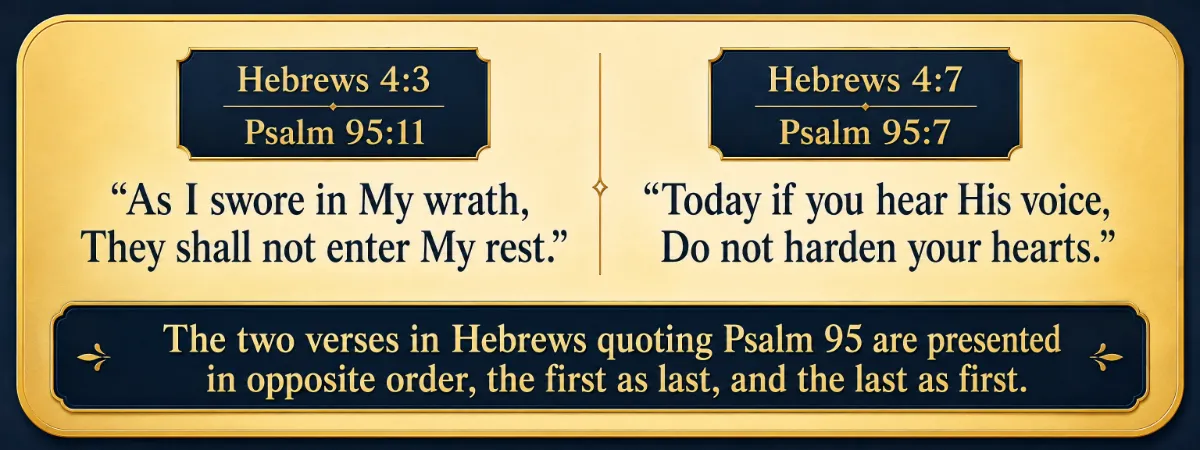
Hebrews 4:3 quotes Psalm 95, a prophetic word from David. Hebrews 4:7, as shown in the diagram above, returns to Psalm 95:7–8.
Joshua’s Promised Land was not the final rest, as David’s prophetic words in verse 7 indicate. David came afterward. And if the Israelites were still in disobedience, the rest found in the Promised Land was inadequate. Their exiles, Northern and Southern kingdoms, would later prove this. Disobedience, the lack of correct activity to please God, frustrates the pursuit of this rest. That rest is not found in the Old Testament. Instead, the Old points to and hints at a new rest, as is commonly noted throughout the Book of Hebrews. With the New Covenant sealed with the Messiah’s blood, which is ever so precious and offers eternal life, we should live out God’s works in obedience to enter into that greater promise of life everlasting.
To summarize, even David’s words about hardening hearts can apply to our lives today, to believers under the New Covenant. We need to persist in our faith and not be drawn away from obeying God’s wonderful provision of salvation in Jesus Christ.
Our works, then, are not the righteousness needed to save us but rather the revealing of a consistent set of choices rooted in our faith in Christ. John describes a similar reality in 1 John 2:19, where some turned away from their faith. Their failure to remain in the fellowship and in right teaching reveals a heart of unbelief. “They were not really of us.”
“They went out from us, but they were not really of us; for if they had been of us, they would have remained with us; but they went out, so that it would be shown that they all are not of us.” (1 John 2:19)
The Word of God and Christ Our Faithful High Priest: Hebrews 4:12–16
12 For the word of God is living and active and sharper than any two-edged sword, and piercing as far as the division of soul and spirit, of both joints and marrow, and able to judge the thoughts and intentions of the heart. 13 And there is no creature hidden from His sight, but all things are open and laid bare to the eyes of Him with whom we have to do. (Heb 4:12–13)
From verse 12 through the end in verse 16, we have a strong statement about the need to remain faithful to God and His word. We are fully accountable to God. He sees and understands our hearts at the most fundamental level. He will rightly judge us. Only after the warning, beginning in verse 14, do we see the affirmation of Christ, our high priest in God’s very presence, who dearly and devotedly persevered for us, serving as our example in persevering and withstanding the great temptation.
Conclusion
We conclude with two exhortations from the final verses: “Let us hold fast our confession” (Heb 4:14) and “Let us draw near with confidence to the throne of grace” (Heb 4:16).
Hebrews 4 does not define how to keep the weekly Sabbath or explain how to gain salvation. Instead, the surrounding verses emphasize the need to remain faithful in our belief. If we follow Christ, we will remain faithful. A persevering faith resists temptation and is revealed in obedience and good works. By continuing in our faith to the end, we enter that eternal rest. “And God rested on the seventh day from all His works.” We follow God when we persistently display our faith through obedience, and we will enter His rest.
Part 1: The Correct Interpretation of Hebrews 4 — A Crucial Hermeneutical Principle »