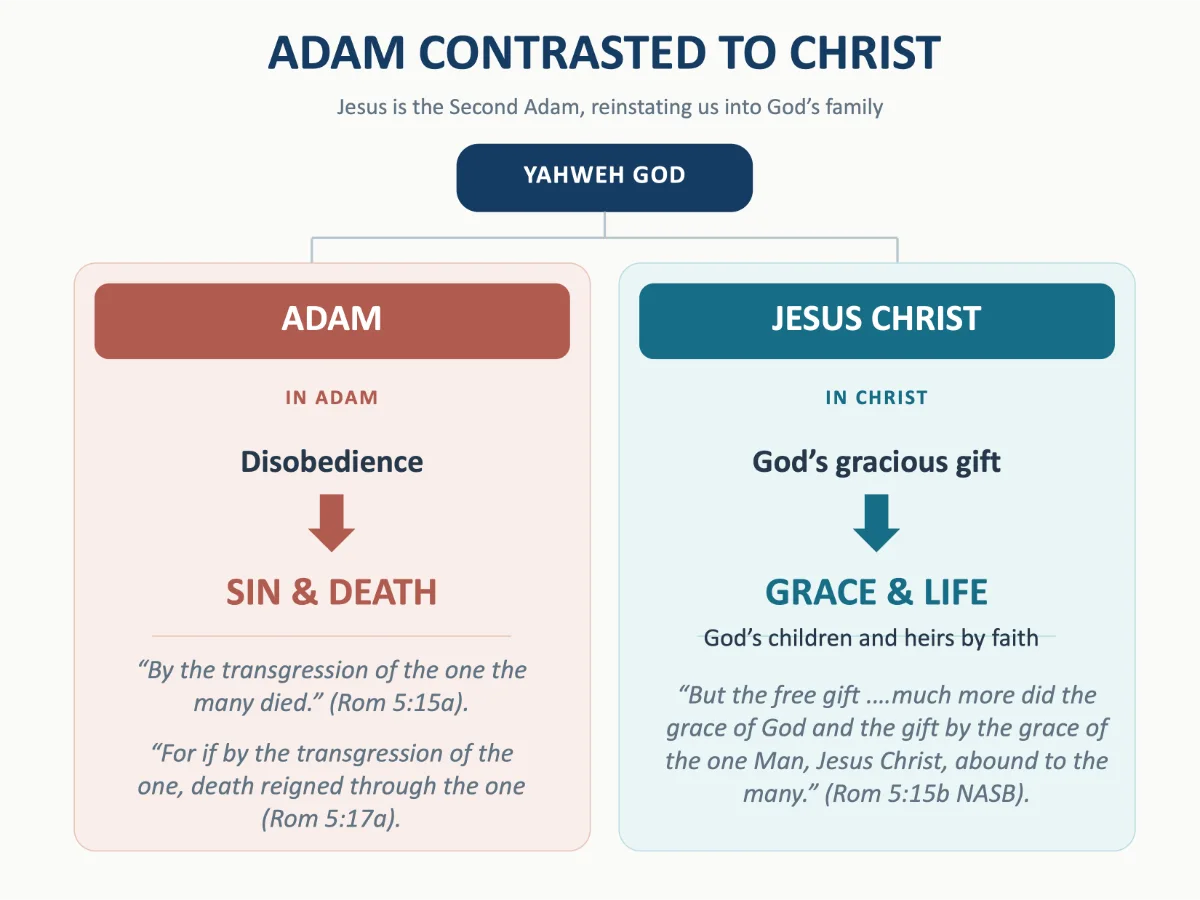
Romans 5:12-21 Handout
FURTHER PROOF OF JUSTIFICATION BY FAITH
One may ask, “Why do we need further proof of justification by faith?” A simple answer is that the Jews needed further convincing that people like you and I (the Gentiles) were part of this salvation plan. Before we elaborate, let us do a little review.
Means of Righteousness (Romans 3:21–5:21)
Not by the Law and works, but by promise.
- Abraham — by faith
- David — by faith
- Abraham’s circumcision
- Abraham’s children
- One died for all
Questions to Consider
- How come I am suffering from another person’s sin?
- What about those people who didn’t know the Law?
- Are they going to suffer judgment?
- How can Christ’s death and resurrection really help people from across cultures and time?
A) Worldwide Stain of Sin and Death (Romans 5:12–14)
- Effects of sin (verse 12)
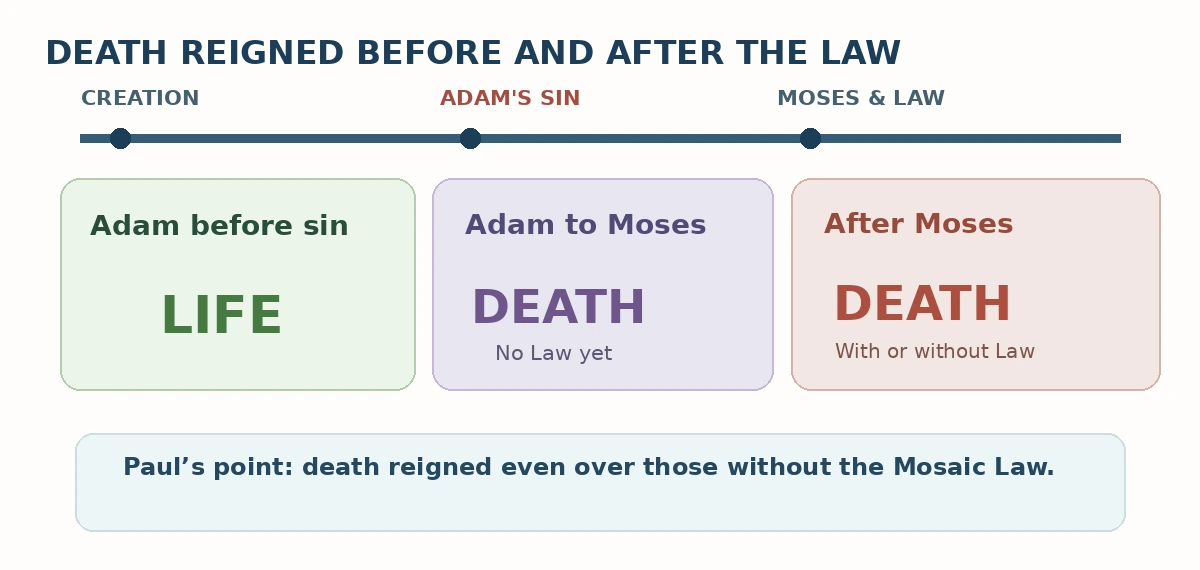
- Sin before the Law (verse 13)
- Grip of sin (verse 14)

Adam sinned. The inherent result of Adam’s sin passed on to mankind along with its evil tendencies, so it penetrated into their lives and became their own sin: sin and death.
How is it that some people were guilty of sin before there was a law? The apostle’s point is that another principle is at work, one that can be explained only by our association with Adam. Adam’s sin affected everyone at the most basic level. Some authors even say this is evident in children dying before birth. Are people naturally innocent at birth?
We need to remember that some people, even now, are living without the laws of Scripture. They have not been revealed to them. Does this mean they are not guilty? How will it affect them on the Day of Judgment?
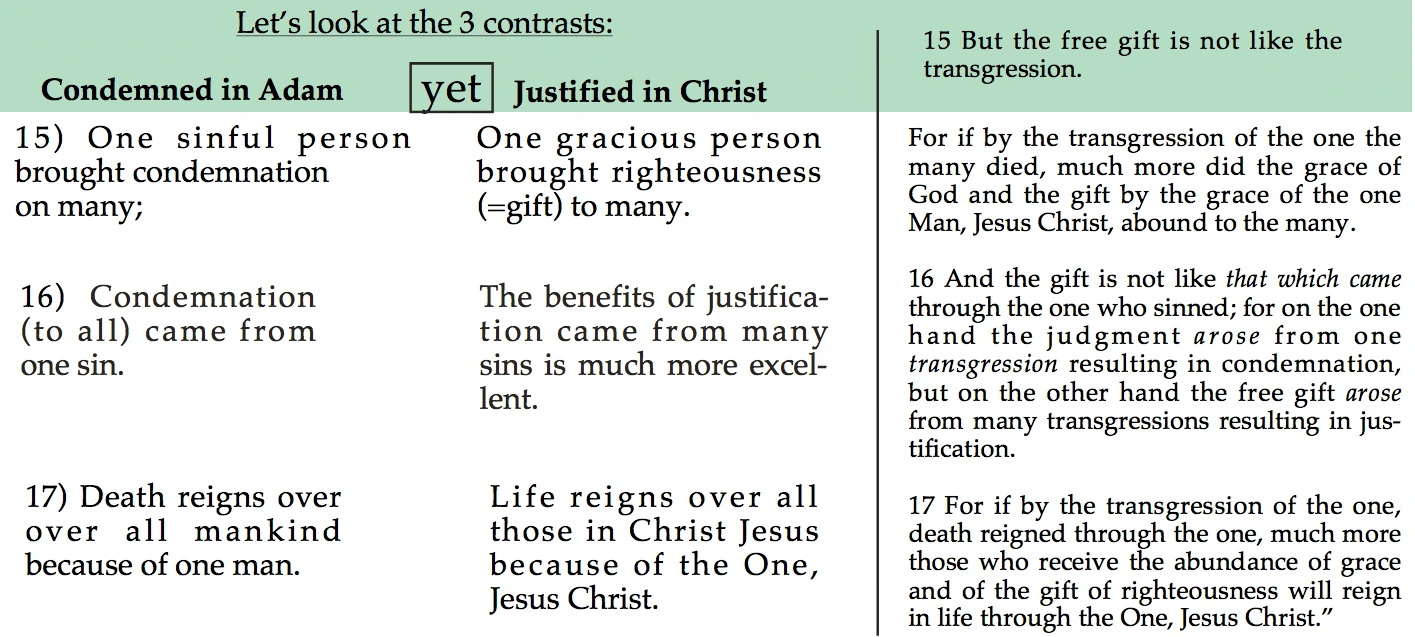
B) Adam and Christ Contrasted (Romans 5:15–17)
“The purpose of 15–17 is to drive home the vast dissimilarity between Christ and Adam, before the formal comparison between them is made in v. 18f, and so to preclude possible misunderstanding of the comparison.”
- Object and result of their work (verse 15)
- The various operations of their work (verses 16–17)
It would be unbelievable if only our curse was taken away, but we get to forever live in God’s abounding grace!
C) Adam and Christ Compared (Romans 5:18–19)
18 So then as through one transgression there resulted condemnation to all men, even so through one act of righteousness there resulted justification of life to all men. 19 For as through the one man's disobedience the many were made sinners, even so through the obedience of the One the many will be made righteous.
- Regarding their work and its effect (verse 18)
- Regarding their obedience (verse 19)
Adam Sinned
The inherent result of Adam’s sin passed on to mankind along with its evil tendencies, so it penetrated into their life and became their own sin: sin and death.
Jesus Obeyed
The inherent result of Jesus’ righteousness passed on to man along with its righteousness and justification, so it came into their life and became their own righteousness (the changing of man’s orientation): righteousness and life.
The parallels are seen in:
| Adam | Christ |
|---|---|
| Condemnation | Righteousness |
| Death oriented | Life giving |
| Disobedience | Obedience |
Additional teaching note on justification
“The design of this section is the illustration of the doctrine of the justification of sinners on the ground of the righteousness of Christ, by a reference to the condemnation of men for the sin of Adam. ... The ground of the sinner’s acceptance with God is not in himself, but the merit of Christ. ... As this idea of men’s being regarded and treated, not according to their own merit, but the merit of another, is contrary to the common mode of thinking among men, and especially contrary to their self-righteous efforts to obtain the divine favour, the apostle illustrates and enforces it by an appeal to the great analogous fact in the history of the world.”
D) The Purpose of God (Romans 5:20–21)
20 And the Law came in that the transgression might increase; but where sin increased, grace abounded all the more, 21 that, as sin reigned in death, even so grace might reign through righteousness to eternal life through Jesus Christ our Lord.
- In respect to the Law (verse 20)
- In respect to grace (verse 21)
The apostle had discussed the Law (3:27–31) before, but not its purpose or timing. Paul uses the Law as a highlighter, wonderfully displaying the magnificent grace of God. The Law came that transgression might increase. As the Law came, man failed all the more. He could not come near the target God had set for man. But because sin increased, God’s grace increased. God, alone, planned for Christ’s work. This work has now altered men’s orientation toward life rather than death.
Questions for Reflection
- What does God think of our efforts to satisfy His wrath by priding ourselves on accomplishing the Law?
- Does that mean we should not do the Law?
From Adam to Christ: The Reign of Grace and Life
In Adam: disobedience, sin, and death. In Christ: God’s gracious gift, righteousness, and life.