
The Heart of Discipleship · Part 6 of 6
Isaiah 50:5–9: The Resolve of a Disciple
“The Lord GOD has opened My ear; And I was not disobedient, Nor did I turn back. (6) I gave My back to those who strike Me, And My cheeks to those who pluck out the beard; I did not cover My face from humiliation and spitting. (7) For the Lord GOD helps Me, Therefore, I am not disgraced; Therefore, I have set My face like flint, And I know that I shall not be ashamed. (8) He who vindicates Me is near; Who will contend with Me? Let us stand up to each other; Who has a case against Me? Let him draw near to Me. (9) Behold, the Lord GOD helps Me; Who is he who condemns Me? Behold, they will all wear out like a garment; The moth will eat them” (Isaiah 50:5-9).
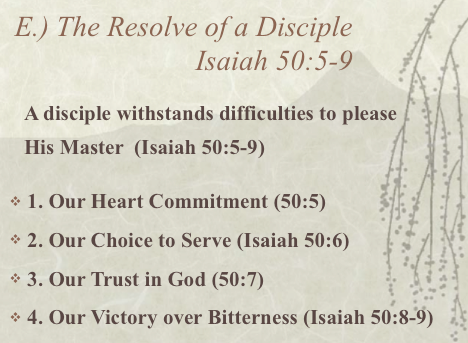
Although we could stop at verse 4, the Servant’s Song continues through verse 9. We might prefer to ignore these verses, but they are crucial to acknowledge and accept. Christians will encounter difficult times. It’s sufficient for the disciple to say he will listen and obey the Lord, but sometimes the true cost of that commitment is unexpected. Here, we will examine four key aspects to properly endure tough times.
1. Our Heart Commitment (50:5)
“The Lord GOD has opened My ear; and I was not disobedient, Nor did I turn back.”
Isaiah 50:5 speaks of opening the ear, while 50:4 speaks of awakening the ear. What’s the difference? Awakening refers to bringing someone out of sleep, whereas opening suggests the need for an operation. Ears don’t close as eyes do. Something serious must be done. We might think of this opening of the ear as an operation. Yes, we know the ears are naturally open; they are inherently open. However, I believe we all understand that opening the ear symbolically refers to an operation of the heart. The word ‘to awaken’ in verse 4 means to rouse or call to attention, but here it signifies taking something that is closed and opening it. Our ears and hearts are not just sleeping; they are closed. We must admit that none of us likes suffering and pain. Something in our hearts needs to change so we can face persecution when necessary.
Jesus, you see, first had to go through a stage of committing Himself to do whatever the Father wanted. It’s encouraging to hear that we should pursue what we enjoy. For example, we like the idea of starting a church and being a pastor. We enjoy helping others with their needs, but things might get tough. We need to be able to say, as Jesus did, “The Lord GOD has opened My ear; and I was not disobedient, nor did I turn back” (Isaiah 50:5).
Let’s think about the Lord Jesus for a moment. Jesus could have had a successful ministry if He had just avoided Jerusalem. He knew that in that city, He would encounter complete and fierce rejection. In fact, He could have kept preaching the kingdom of God in Galilee, or even in Samaria or among the Gentiles. Surely, people would have flocked to hear Him speak and see the miracles He performed. But we know this would have meant missing a crucial part of the ministry that the Father had planned for the Son. Jesus made this very clear.
“And he who does not take his cross and follow after Me is not worthy of Me” (Matthew 10:38).
“Then Jesus said to His disciples, ‘If anyone wishes to come after Me, let him deny himself, and take up his cross, and follow Me’” (Matthew 16:24).
“And He was saying to them all, ‘If anyone wishes to come after Me, let him deny himself, and take up his cross daily, and follow Me’” (Luke 9:23).
Perhaps we can phrase it this way: “God Yahweh broke the door of resistance that would hold back a full and complete dedication to doing whatever the Lord wants.” This clearly reflects the meaning of this verse, as the disciple immediately responded, “And I was not disobedient, nor did I turn back.”
There is no doubt that each of us must complete this step in our discipleship if it is to be meaningful. Without facing opposition, it may be easy to settle for a superficial kind of discipleship. We claim to be fully committed, but when challenges arise, we often turn back. If we are not fully committed, our service remains half-hearted.
“He who is a hireling, and not a shepherd, who is not the owner of the sheep, beholds the wolf coming, and leaves the sheep, and flees, and the wolf snatches them, and scatters them” (John 10:12).
I once traveled with some good Christian brothers to a distant city for pastor training. The conversation turned to how careful we needed to be in the city we were going to. There were many Hindu activists there. The key brother said, “Yeah, I didn’t want to tell you earlier.” He was afraid I might not come. After all, this was the place where a missionary named Stanley from Australia was torched to death in his car with his two sons. Fortunately, I already understood the mission's sensitivity. But God had to open my heart and make me willing to go where I might face danger.
We need to realize that the Lord is training us, while Satan is trying to distract us. Although Christ could have said that God had opened his ears, perhaps we will need to go through several special training situations that make us more usable.
I recently read through the Old Testament historical books, starting with Judges and ending with 2 Chronicles. I cannot help but be troubled by how many times a man begins right but does not end right. King Jehoshaphat in 2 Chronicles 20 won one of the most remarkable battles in history. He sent his musicians ahead of the army. When they began to play, the enemy turned on each other and destroyed each other. Yet, it is the same king who later allied himself with Ahaziah, the king of Israel. The scriptures are clear: “He acted wickedly in so doing” (2 Chronicles 20:35), and he forced God to judge him. Jehoshaphat turned back at the end. We need to focus on being disciples all our lives. Never get too comfortable. Never assume everything is going well. This is a battle, and the evil one wants to cause us to fall short. He wants us to turn away from fully trusting God, even when times get tough.
2. Our Choice to Serve (Isaiah 50:6)
Isaiah 50:6 shows how the Servant, the faithful disciple, performed three incredible acts. Today, it might seem like He was being victimized. Maybe others thought they had control, but that’s not what we see here at all. Notice how it is written.
(1) “I gave My back to those who strike Me.”
(2) “I gave … My cheeks to those who pluck out the beard.”
(3) “I did not cover My face from humiliation and spitting.”
What do we see here? The servant fully understands that the Lord God is in control. Any challenging times that His servants face are not by accident. They are, first of all, completely overseen by our sovereign God. As a result, they become special requests for His servants to bear. We might think of it as the Lord saying, “I need you to endure....” This testing then becomes an opportunity for us to obey Him. It becomes our choice.
Usually, we make these choices in advance. Like Jesus, He came to serve and save the lost. The decision is made beforehand, often at a special moment of dedication. The Lord prepares our hearts for His work, as we've discussed before. When we face actual testing, each step of obedience confirms our previous decision. This is what we see Jesus doing so clearly. “I gave....” “I gave....” “I did not cover....”
These trials each serve as our personal confirmations of obedience. Simultaneously, they present unique opportunities to observe how the Lord will use these challenging situations for His greater good. Let us examine the three requests that God Yahweh made to Christ.
He turned His back to those who struck Him. We remember the flogging before Jesus’ death. This life-threatening beating made it so that Jesus couldn’t even carry the wooden cross to where it needed to be placed. Someone else had to carry it, but note, this was not Pilate’s decision. Nor was it the Jews’ decision, even though it was they who shouted, “Crucify Him!” It was primarily Christ’s decision. He faced Jerusalem. He chose it because He chose to do His Father’s will.
He allowed his cheeks to be plucked by those who tore out his beard. This act of plucking is the most humbling and painful. But again, it was not his tormentors’ first choice to do this; it was Christ’s—“I gave…my cheeks…” Jesus said to Pilate.
“Pilate therefore said to Him, ‘You do not speak to me? Do you not know that I have authority to release You, and I have authority to crucify You?’ Jesus answered, ‘You would have no authority over Me, unless it had been given you from above; for this reason he who delivered Me up to you has the greater sin’” (John 19:10-11).
Third, we see that Jesus did not hide His face from humiliation and spitting. He did this for us. This was the One without sin who became sin for us. How do you handle people’s offensive words and actions? These situations demand our decision. Jesus was, after all, doing what His Father wanted. As long as His Father asked Him to do something, it was a morally right action. He was doing well. Even though, from man’s perspective, there was great shame involved. He did it to please His Father in heaven and holds that privilege with great honor and respect. He did not cover His face with shame.
Application
The evil one often comes and tries to torment us with thoughts like, “He doesn’t love you. See!” or “You have wasted your life and effort.” During persecution and trials, Satan uses these moments to persuade us to adopt an unbiblical perspective. He wants us to doubt God’s overall goodwill.
We only need to trust our Lord and follow Christ’s example, and we can be in the very presence of God—even if we end up being recklessly mistreated. You are not alone when you suffer; brothers and sisters around the world suffer with you. But remember, you are in God’s glorious presence. There is no shame in obeying the Lord. If He allows difficult times for you, then you must go through them. He has carefully prepared the works we are to do (Ephesians 2:10). Listen to what the Lord says to the church in Smyrna.
“And to the angel of the church in Smyrna write: The first and the last, who was dead, and has come to life, says this: ‘I know your tribulation and your poverty (but you are rich), and the blasphemy by those who say they are Jews and are not, but are a synagogue of Satan. ‘Do not fear what you are about to suffer. Behold, the devil is about to cast some of you into prison, that you may be tested, and you will have tribulation ten days. Be faithful until death, and I will give you the crown of life” (Revelation 2:8-10).
The Lord has various paths for us to travel. We are simply His servants and will follow our Master’s requests. Choosing to obey the Lord’s will is our decision. But how can we withstand such scorn and suffering? This is what He next addresses.
3. Our Trust in God (50:7)
“For the Lord GOD helps Me, Therefore, I am not disgraced; Therefore, I have set My face like flint,
And I know that I shall not be ashamed.”
The secret, of course, is not in denying the pain. No. Pain is pain. Some religions would have us believe that pain is an illusion. But in fact, pain is very real.
Seeing loved ones hurt because of our enemies in their attempt to weaken our resolve is incredibly painful. There are accounts of how they kill a father’s children and wife in front of him so that he will turn away from His faith in God. What tremendous pain! The secret to enduring this kind of suffering is found here in verse 7. Yahweh God helps us.
So, how does God help Christ? “For the Lord God helps me.” Jesus said He could have had legions of angels to rescue Him.
“Or do you think that I cannot appeal to My Father, and He will at once put at My disposal more than twelve legions of angels?” (Matthew 26:53)
One legion consisted of about 6,700 men. This would have been twelve times that number, nearly 80,000. It might seem natural to assume that the presence of these angels would be a way for God to help Him, but in reality, they became part of the test for Him. Jesus understood that having provision didn't necessarily mean it was God’s will. Jesus never asked angels to prevent Him from doing His Father’s will; instead, He asked for help to do God’s will. This is what we need to remember. God’s grace helps us to do His will.
“Let us therefore draw near with confidence to the throne of grace, that we may receive mercy and may find grace to help in time of need” (Hebrews 4:16).
At the throne of grace
There at the throne of grace, we may find all the mercy and grace we need to help in times of trouble. We do not need to worry whether His grace is enough. Paul said the same thing about His difficult trials.
“And He has said to me, ‘My grace is sufficient for you, for power is perfected in weakness.’ Most gladly, therefore, I will rather boast about my weaknesses, that the power of Christ may dwell in me” (2 Cor 12:9).
Many spend their valuable time and energy trying to hide their weaknesses. Paul also had his weaknesses but learned to boast in them. He discovered that every desperate situation could become an opportunity for God to help him in a special way. If his Master had given him that weakness, then he could be confident that his vulnerability was important for his service. Instead of avoiding his weaknesses, Paul chose to accept them by faith and even boast about them.
The Lord has humbled me over the past years. At times, I was unsure about where I would fit into ministry. We didn’t have a steady income. Let me focus on the latter part. With a family of 10, including older children, we faced many expenses.
Meanwhile, I chose to establish a ministry that distributes training materials to assist others in their ministry. The Lord has allowed us to live on the edge. We have no savings. If we run out of money, we simply do not spend.
I might think I could serve the Lord better if I had this or that, but He doesn’t see it that way. This so-called weakness is how He has further trained me. While others can talk about what they have saved for retirement, I have learned to boast in how He cares for us even when we have nothing. God, however, has used this very lifestyle to prepare me to minister to others who live by faith overseas. I can strongly relate to their poverty and extreme needs because I share similar difficult circumstances. I focus on serving my Lord with what He has given me, and He has shown Himself to be very faithful.
When I face disgrace in battle, I need to remember Jesus’ example. Many around me have much more. I could probably join them by finding more ‘secure’ positions. When I compare myself to others, I feel ashamed of where I am. Satan is ready to step in and make me feel terrible. I’ve learned to counter that by focusing on my choice to do God’s will. This is more important to me than anything else. I’d rather starve doing His will than eat comfortably in disobedience. Thinking this way strengthens and encourages me. What might be an embarrassment becomes my joy and privilege.
When it says that the Lord will help, it means that God will give us all the grace we need to do His will. Because of this, we will not be emotionally discouraged or disgraced. We have set our minds on serving the Lord in whatever circumstances He brings our way. We can be sure that the situation is no accident.
Application
What are your current circumstances? What weaknesses do you possess? Are you still emotionally struggling with them? Are you still trying to escape from them? Slow down and, like Jesus, see:
(1) That God will give you all you need to accomplish what He asks of you.
(2) That the weakness is deliberately given to you for a certain time so that your Master in Heaven can better accomplish His will through your life. Praise God for your weaknesses. Thank Him for them and endure this situation for as long as He wants. Be glad it will not be forever with a promised new body.
(3) That the moment the trial is not needed, it will be gone. God is our help, and therefore, we need not be ashamed.
4. Our Victory over Bitterness (Isaiah 50:8-9)
“He who vindicates Me is near; who will contend with Me? Let us stand up to each other; who has a case against Me? Let him draw near to Me. Behold, the Lord GOD helps Me; Who is he who condemns Me? Behold, they will all wear out like a garment; The moth will eat them” (Isaiah 50:8-9).
Bitterness must be overcome if we are going to follow Jesus’ example faithfully. Satan wants to use bitterness in our hearts to block God’s grace. If we do not forgive, the Lord says He will not forgive us.
“For if you forgive men for their transgressions, your heavenly Father will also forgive you. But if you do not forgive men, then your Father will not forgive your transgressions” (Matthew 6:14-15).
Let’s examine how this passage clarifies the issue.
Not seeking revenge
Not blind to injustice
Evil is not the same as His judgment
God’s judgment is coming soon
Not seeking revenge
Jesus clearly affirms that it is not He who will bring about revenge for the evil done to Him on earth. “He who vindicates Me is near.” God the Father will deliver justice at the right time. The Servant trusts God to handle these matters, as scripture advises us.
“Never take your own revenge, beloved, but leave room for the wrath of God, for it is written, ‘Vengeance is mine, I will repay, ‘says the Lord” (Romans 12:19).
Revenge is God’s responsibility. We should not misuse this idea to think that justice isn’t needed or that God hesitates when it comes to enforcing justice.
He basically says that we should not take revenge into our own hands. We are to forgive others, refusing to live with a spirit of pride or compare how we are better than they are, or how they deserve this or that. It is true that those who hurt us or intentionally hurt us do deserve judgment, but we are to entrust the matter to the Lord’s hands. Our job is to forgive. Satan wants us to step out of order and act superior to others. Remember Jesus’ famous words, “Father, forgive them; for they do not know what they are doing” (Luke 23:34). Jesus, in these verses, helps us to keep our perspectives straight.
First, we see that He recognizes the wrongness of the situation. He was not blind to all the unjust actions done to Him. Neither do we need to pretend that the guilty are innocent. In fact, they have committed very wrong acts, and every time something wrong occurs, it becomes another court case that will one day be settled. God is just and does not take lightly the wrongs committed. We might dismiss sin, but God never can or will. Each sin demands full justice. It is okay to admit something was wrong, even if it is against us, but do not think that evil will last. It won’t.
Second, we must acknowledge that every wrongful deed will be corrected. When we step back and admit that it is not us who will make things right, we can find peace. The temptation is to seek revenge instead of opportunities to show grace before the right time by contemplating our tactics. God is jealous of His justice. We dare not carry out on earth what only He can do at His coming. We need to wait for His timing.
God, right now, before His Second Coming, delays judgment to offer us extra grace. Today is the day of salvation. We should focus on sharing God’s love and light with this generation rather than on His judgment.
Third, we should not assume that the evil that comes upon us is His complete and final judgment. It could, of course, be a sign of the judgment that awaits us. We might commit our sexual sins and find out we have some form of STD. But when we are faithfully serving the Lord, like Christ, suffering, pain, or tribulation does not mean we are doing something wrong. Instead, it often means we are doing something right!
Lastly, God’s judgment is soon to come. It helps us stand firm when evil appears so powerful. We do not rely on our own strength for this. “He who vindicates me is near.” “Behold, the Lord God helps Me.” With this confidence, he can say, “Who is he who condemns Me? Behold, they will all wear out like a garment; The moth will eat them.” Evil will be wiped out. Justice will be fully upheld. Our world currently commits many injustices. God has delayed this age of injustice so that He might show His grace to many. If He had brought judgment earlier, we all would have perished. Earth would have been destroyed many years ago.
Application
Are you seeking revenge now? How do people take revenge? Either by planning to do harm or by actually harming someone. Some talk behind others’ backs. Others lie about someone. Some might even steal from someone while justifying their actions.
Most often, people carry their pain in a bag called an unforgiving spirit. This unforgiving spirit does not live out God’s love and grace, and therefore, as far as we are concerned, is also sin. Paul says it in a very special way, quoting from the Old Testament.
“Never take your own revenge, beloved, but leave room for the wrath of God, for it is written, ‘VENGEANCE IS MINE, I WILL REPAY,’ says the Lord. ‘BUT IF YOUR ENEMY IS HUNGRY, FEED HIM, AND IF HE IS THIRSTY, GIVE HIM A DRINK; FOR IN SO DOING YOU WILL HEAP BURNING COALS UPON HIS HEAD.’ Do not be overcome by evil, but overcome evil with good” (Romans 12:19-21).
The only way we can repay others is by loving them as God graciously loved us. The man of God is not tempted to repay evil with evil. He is too focused on living out the ways of the kingdom. Satan wants us to be offended so that we withhold grace. That is his evil plan, but we choose to walk in faith, trusting that God will, at the right time and in the right way, judge those who do wrong. This enables us to concentrate on doing good.
What if someone is talking behind your back? You should forgive them and try to bring extra grace into their lives. Yes, they might laugh at you. Who cares? Remember, we are here to please our Master in heaven. We are, as Paul repeatedly states, God’s servants. We are His servants.
What if someone has stolen some of your sheep (i.e., church members) by saying something terrible about you and something good about himself? Entrust the situation to the Lord. If they settle into His church, talk to the Chief Shepherd and leave it to Him to handle. But you should follow this by somehow overcoming evil with good.
Summary
Let us be disciples who never stop growing in communion with God. The evil one wants to break our fellowship so that bitterness arises. Forgiveness is like an oil that makes hard-working parts work smoothly.
God’s will guides the life of the great servant of God. The best disciple is shaped by His master’s purpose and will. We see this clearly with Jesus. The Lord Yahweh became Christ’s life. Just like the hub of a wheel, every part of the wheel constantly revolves around the center hub.
Nothing exists without being anchored to its central point. It may be jostled and its angle may constantly change. It may be clean or dirty, but it is fixed around a core, just like Christ Jesus. He lived to fulfill His Father’s will. And that must also be true for us as Christ’s disciples. In Christ, our lives revolve around the Lord our Maker and Savior. We have no other purpose but to live for Him and His will.
Indeed, we have no higher calling and no grander opportunity than to be like Jesus, our Master.

We are not perfect, but as we grow through life, we increasingly resemble our Father. We become more like Jesus when we spend quality time with Him and share His purposes.
Exercises on Discipleship
Our discipleship programs often fail because we do not introduce God's people to God through Christ, but rather to ourselves. We follow the ways of the world, trusting in what we have learned in the past instead of what the Father wants to teach us each day. Looking at Isaiah 50:4-5, we find valuable insight into how we should live out our Christian lives for effective service.
Reflect on the discipleship and mentoring you’ve participated in based on the above reference. Have they guided you and others to follow Christ?
Also consider your thoughts on discipleship. Are they centered on following Jesus or on being a ‘good’ Christian?
Continue with the Study Questions
Review all five traits of a disciple and use the complete question set for personal reflection, group discussion, or teaching.
Study and Application Questions
- What did the Lord do to His ear (50:5)? What does this mean?
- What is the difference between awakening (4) and opening an ear (5)?
- What was the effect of this in the Servant’s life (5)?
- How committed are you to doing God’s will no matter where, what, or when?
- What are the three things He says He does in verse 6?
- Why does He say He does it rather than His enemies doing it to Him?
- In verse 7, it says God helps Him. How does God help Him when suffering pain?
- How do you handle pain and suffering (7)? Do you blame God or trust Him?
- What were His attitudes toward those who mistreated Him (8–9)? How do you know?
- Do you always forgive everyone? Why or why not?
- Why should you forgive others?
- How do all of these verses (50:4–9), featuring the example of Christ, give you extra motivation to faithfully follow and become more like Christ?