
Chapter 6: Overcome Pride, Cling to Humility
#61 Embracing the Truth
Discipleship Level 2: Reaching Beyond Mediocrity
By Paul J. Bucknell

Purpose: How confession and truth work together to move the believer from sin toward righteousness and freedom in Christ.
#61 Embracing the Truth
Introduction
- Learn how to expose your heart to the truth of God. This training is not just battling against the evil one’s malicious purposes but is also the pathway to usher us closer to the Father, away from the distractions of the world, and into the rich joy and love of God.
Delightfully Affected
It is insufficient to merely know the truth intellectually. We must internalize it until we are delightfully persuaded by its power. Let me give an example.
I recently was making some adjustments to two barrels so that we could catch rain water for our garden. They had not been adequately secured and so in the middle of the storm the connecting pipe fell off and the water was gushing out. So, in the middle of the storm, I went out to correct things. Needless to say, by the time I was done, every layer of my clothing was completely saturated. I had to put on a whole new set of dry clothes. The water had reached every part of my body.
We similarly want the truth to touch every part of our lives. In order to embrace His truth, we need to pray and meditate in God’s word. We have already begun to speak about these things, but some of these steps are being restated from a different perspective as it is crucial to the process of overthrowing pride and putting on humility.
Prayers of Confession
Confession of our pride stands as an essential step to eradicating pride. We do not want to keep asking forgiveness for the same thing, but we must thoroughly confess everything that we have done wrong that might have offended our God. We desire a full cleansing. For instance, a little boy after washing his hands might show them to his Mom and say to her, “I’m clean!” But, when the mother checks his hands, she discovers that only a small part of his dirty hands is clean!
Confession is our sincere statement of agreement with what is true about our pride, the pain it has brought to others, and even how we have held back giving proper glory to God. We bring that confession to God through Christ, our high priest, and seek full forgiveness for those sins. 64
Helping Others
At times, when mentoring a brother, though he might start confessing his sins, I must gently remind him—even in the midst of his praying—how he needs to add this or that to his confession. Why? Like the previous example, I know that he has left out certain admissions of wrong that should have been included. So I encourage the person to make a complete confession. One example might be, “Don’t forget to confess your prideful and hostile spirit toward your parents.”
Of course, a person’s confession must be personal and genuine. God is looking at our hearts when we pray. In the end, prayer is not a string of magical words. If someone says a prayer that is not his own, then it is merely a religious act without any spiritual power.
We will never be able to fully know or remember all of our sins, but we 64 should deal with them specifically as we remember them. Have you been prideful toward a person? Then confess that specific sin. But we also have general confessions for all the people, even ones we do not know of, that we have disdained.
Thoroughness of Confession
We should try to confess all our sins in one setting so that no unconfessed sin remains hidden in our soul. The evil one has easier access to our lives through unconfessed sin (this is why it says do not go to sleep with anger in one’s heart, Ephesians 4:26).
This illustration clarifies what I mean by thoroughness: While driving, we may be able to see a long distance in front of us, but that does not mean we can see all the details of what’s ahead. We cannot read those distant signs or activities on the road or perhaps around the bend, no matter how hard we might try. It is too far off, or maybe yet hidden from us. Spiritually speaking, it is the same. We must thoroughly deal with what we can clearly see. Once we get up closer to what was once far ahead, we can see those details and effectively deal with them.
First Things First
Sins that first come into our minds, whether they seem major or not, must be immediately dealt with. (That’s right—no excuses, avoiding or putting off.) After these prideful thoughts, words, or actions are dealt with, other sins often come into view as the Holy Spirit works through each area of our life.
Once one area is cleared up, then other things come into focus. As past unconfessed sins come to your mind, pause what you are doing, confess that specific thing on the spot and continue on with what you were doing. Learn to make confession wherever you are. Confession is like breathing. Do it as often as you need. This does not mean that it should be lightly handled, but thankfully, because of the grace in Christ Jesus, it is that easy. Praise God for that!
There is no penance, no offering, no lighting of candles or good works necessary to obtain forgiveness, though God might want you to take actions to make reconciliation with others
(Zaccheus, for example, in Luke 19:8-9). Pardon comes from Christ’s work on the cross for us rather than from our good works. We cannot earn this pardon, but we can rejoice in our Savior who obtained it for us. But we must faithfully implement these powerful steps into our lives.
Remember that in our confession we want to mention all our poor attitudes, wrong actions, and bad responses. Don’t forget to include specific ways we have been rude, spiteful or arrogant to others. Usually a multitude of sins occur when we accept Satan’s spirit of pride in our lives.
Reoccurring Memories of the Bad Past
There might be reoccurring memories of formerly confessed sins that pop back into your mind after the initial time of confession. Make sure you have properly confessed these sins. If you genuinely have forgotten whether you have appropriately confessed these sins, just repeat your confession. However, if you have confessed a sin and its guilty shadow returns, just return to where you were formerly in your confession. Reaffirm your brokenness over that pride and thank the Lord for His full cleansing by His blood. We do not need to again ask for forgiveness. Just thank Him. He has already cleansed you. Usually, His peace returns to your heart then.
Satan is the Accuser (Revelation 12:10), and as such, he often tries to confuse us about our forgiven state and ensnare us through some guilt trip. By bringing up a past offense, he is also trying to stir up the old proud response. “Do you remember what they said to you? Are you going to let them get away with that?”
By simply focusing on the Lord’s forgiveness and not latching onto some past negative experience, we focus on Jesus and delight in the truth about His thorough washing of our sins. Perhaps you could respond, “Lord I thank you for forgiving me
for being so hostile toward them in the past. I have forgiven them and you have forgiven me. I ask that you would open their hearts to know the fullness of your love.” Do you see how this prayer works? Declare the Lord’s forgiveness of your sins and your forgiveness of the other party. And again, seek God’s work of love in their lives. The evil one does not want his temptations to prompt you to pray for others and will soon leave you alone.
Temptation’s Power
As strong as temptation might be, it is not sin. Temptation is merely Satan’s suggestive thoughts being brought to bear on your mind. It only becomes sin when you adopt it as your own and make decisions according to its suggestion. An illustration will help. Maybe I am having my quiet time, and a thought springs up about how I am better than most people in the church because I read my Bible each day. This prideful thought (temptation) is not sin, in and of itself, but I need to be very careful how I respond to its presence.
The way we interact with the words of temptation will either bring us into sin or keep us out of it. If we become absorbed by the thought of being better than others, we have succumbed to pride. It is at this point that temptation becomes sin, and we need to confess it as our sin and offense against God.
If, on the other hand, we take out the sword of the Spirit (i.e., the Word of God, Ephesians 6:17) by responding to biblical truths: “Lord, you know none of us have any hope without you powerfully working in our lives through your Word. Come, enrich each brother and sister in our congregation and mightily use them.” When we respond opposite to the way the evil one wanted, we come “in the opposite spirit”—instead of despising others and adoring ourselves, we chose to pray for God’s success for everyone.
Our purpose is to confess all of our sin so that the evil one has no remaining cords of darkness to pull us down. This enables us to draw closer to God in our souls. Once we thoroughly 65
handle our prideful thoughts, ways, and antics, then, we can move on in true worship of God.
In Jesus’ Name
Pray to the Father as Jesus directed us in the Lord’s Prayer. A prayer of confession seems like it should be prayed to Jesus Christ, but Jesus clearly instructs us that we are to pray to the Father in Jesus’ Name (Matthew 6:9; John 16:23). The Father, in his compassion, sent Jesus, and He cares for us. Here is a short confessional prayer of pride.
“Dear Father in Heaven, I am horrified at my pride. O Lord forgive me. I have been so stuck in my attitudes. I didn’t care about others, even when they were busy or uptight. I only thought about myself. Lord, you did not make me to be served but to serve. Please forgive me of my selfish and prideful attitudes as well as all the wrongful things I did. I did not love Jackie or Sally as I should have. I cannot believe how snobbish I was. Please forgive me. I need Christ’s blood to cover all my sins. Thank you so much for your kindness in forgiving me. I give praise to you. In Christ’s Name I pray, Amen.”
Affirmation in Prayer
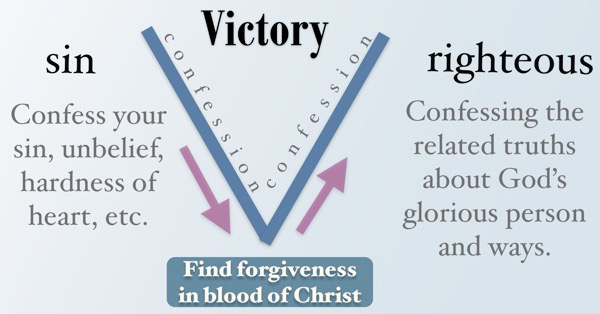
The V diagram below reminds us that victory comes through making truthful statements of the wretchedness of our soul,
This statement might cause people to wonder whether God is always close 65 to His people. We should best think of our relationship with God as a personal relationship or friendship. The more intimate time with Him, the closer we are. If we are not totally genuine with Him, this negatively affects our relationship.
followed up with declarations of truth about God, His ways, and our given situation.
Even the part in our confessional prayer that declares how we are forgiven through Christ’s blood becomes an affirmation. Forgiveness, as illustrated in the V diagram, joins the two sides —at the bottom at the cross.
The two terms of confession and affirmation are used to make sure both parts of the confession are included. Affirmation is really just another side of confession. Some of us will naturally do this while others are just learning. Do not stop with confession of your sins and leave yourself unprotected by the truth of God! (This would be like taking off our soiled clothes but not redressing!) We desperately need to rise up, boldly declare God’s truths to casts its light on the ways of darkness, and help us to spot strongholds of darkness still alive in our souls, hearts, and minds.
The Release
During this proper declaration of God’s Word related to our pride, something special happens to our souls. We are released to better understand and believe God’s truth. The darkness is pushed aside. With each announcement of what is true, lovely, good, pure, right, etc., (see Philippians 4:8-9), we sense a further release by the Spirit of God from the hold of darkness blinding us from the glory of God and His ways.
This release indicates a former resistance to God’s truths; for when they are made apparent, they escort us into a stronger and more vibrant belief. Our faith grows. This happens during a worship song, powerful sermon, reading of God’s Word, but nothing is like the targeted prayer that declares these truths of God, especially after times of confession. This is the right side of the V, the ascending side. We want to declare the powerful truths about God and His ways. If our problem has been pride, withholding genuine praise and honor has been a real problem. Release it now. Declare God’s glorious wisdom, power, and mercy. As Paul says, “To the only wise God, through Jesus Christ, be the glory forever. Amen” (Romans 16:27).
Our Prayers
Pray these truths aloud until they begin to grab hold of your attention. You should sense a strengthening of faith. As this faith enters, you will be much more inclined to humbly live in the light of this truth. It is not hard, but it does require an act of our wills. The more often we pray this way, the more confidence we will have of this process. Again, this whole discipline is built on the way light’s power exposes darkness and illuminates what is true and good and not on the magic of saying certain prayers.
Paul closely links this process with the taking off of the old man and putting on the new (Ephesians 4:22-32). The illustration is from our everyday lives. People regularly take off their dirty clothes and put on clean ones. No one only remove his dirty clothes and remains naked, and nobody just puts on a layer of clean clothes over the dirty ones. The taking off and the putting on are both important steps to a strong Christian life.
When our minds are focused on these truths, we are putting on the truths of God. This gives us confidence (faith) to embrace God and all His will rather than allowing the influence of the dark thoughts and deeds of the evil one.
The Exchange Prayer
As we close this section, we will examine a prayer of confession. This prayer is based on the truths mentioned earlier in this section on pride. Remember to combine a healthy declaration of God’s glorious power, ways, and goodness along with the confession of sin. So many verses help fill in the powerful truth phrases that can be used.
Let’s call this the Exchange Prayer. We will (1) replace (take off) pride stemming from wealth and position and (2) exercise (put on) love for the Lord and express willingness to use what we have for His glorious purposes.
“Dear Father, thank you so much for working in my life. I can’t believe how selfish and ungrateful I have been toward you, especially considering how well you have taken care of me. In the past, I selfishly sought after money. I treated it as mine, and so I unwisely spent it and showed it off. Please forgive and cleanse me from these sins through Jesus’ death on the cross.
Lord, you have graciously opened my eyes and heart not only to my pride and self-ambition but to how You have entrusted these resources to me for a special reason beyond myself. Much is expected from me because I have received much from You. Right now, I want to commit myself in two ways:
1) I never want to show off what I have to others. I desire to dutifully handle my resources so that Your Name is honored. I want to demonstrate my appreciation for your work in my life by properly using my resources. Starting right now, I will use my car and house to help others. How people might think of me will no longer be important. I want to please you.
2) Second, I thought that the more I received, the better off I was. That was a delusion. Thank you for helping me to see through this. Now I know that it is better to
give than to receive. I want to be a giver. I want to be more blessed. Help me, Lord, to be deeply influenced by Jesus’ words. Right now I am going to start by emptying one of my accounts and use the money to give past tithes to the church and overdue gifts to Christian organizations and missionaries. Lead me to responsibly carry out this process and complete it within the next month. This is only phase one of the changes you want in my life, O Lord. May my life please you, but I need your help guiding me on understanding what you want from my life and resources. Praise You that I am free from being a slave to my pride, covetousness, and wealth. I delight wholly in Christ’s Name and in Him I pray. Amen.”
Notice the truths in this prayer. Using the V diagram as a model, this believer used the ascending side to gain a clearer perspective of what God wanted for his or her life and resources. You, too, declare the truths as God opens your heart and commit yourself to practically apply them to your lives. (He often reveals this in our prayer times.) In this way, you are covering up the crevices that the devil’s lies formerly filled.
The evil one will probably tempt you after such a prayer and say you are a fool for doing this. Tell the Lord, “I might be foolish in the world’s eyes but, to please you is my heart’s desire. Thank you for so richly blessing me with your presence!” Fight darkness with light wherever it appears!
Points of Reflection
What does “embracing the truth” mean? What illustration was given?
Why is thoroughness so important in confession?
Explain the process of confessing our sins. What do we do first? What follows?
Give an example of how affirming the truths of God has, at some point in the past, helped you.
Have you ever experienced an increase in awareness of the truths of God that helped you take significant steps forward in your fight against evil and gaining intimacy with God? Explain and share an example if possible.