Part 1: The Needy Heart of Man
John 5:1–9a · The Spring of True Hope · Part 1 of 2
Paul J. Bucknell
Jesus meets a helpless man at the Pool of Bethesda, showing why the deepest need of the human heart is greater than physical healing.
Key point: John 5:1-24 reveals the depths of mankind’s needs and significantly points to the only means by which they can find thorough healing of the soul and the promise of eternal life through Christ’s work on the cross.
Introduction to John 5
From the beginning of John to the end, John uses many signs, incidents, and teachings of Jesus to point us to the key life-changing events of our faith in Jesus Christ.
These signs and teachings in the Gospel of John are like lights guiding a vessel safely into a foggy harbor. As it draws closer, other lights appear, steering it away from danger and into the safety of the harbor.
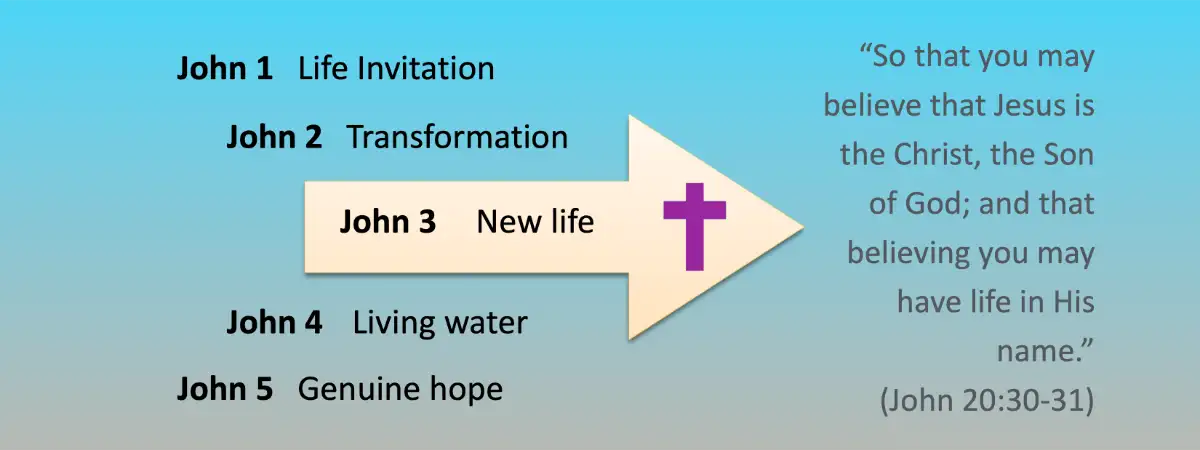
30 Therefore many other signs Jesus also performed in the presence of the disciples, which are not written in this book; 31 but these have been written so that you may believe that Jesus is the Christ, the Son of God; and that believing you may have life in His name. (John 20:30-31)
- John 1 God’s Invitation: Jesus, the Light and the Life, offers truth and grace to reconcile man to God and bring them into God’s family.
- John 2 Transformation: Jesus could offer those present new wine, but He needed to offer His blood to offer genuine hope to the world.
- John 3 New Life: Jesus offered His life on the cross to bring spiritual life by the Holy Spirit to create the new Israel.
- John 4 Living Waters: Jesus reaches out to the rejected, offering living water that can quench the thirst of any life.
- John 5 Genuine hope: Jesus offers healing and hope to the most hopeless.
Mankind’s problems go much deeper than the bandage that the modern world offers with its wealth, education, and science. The keys to mastering all sorts of knowledge or fantasy are now offered to anyone who wants to mesmerize themselves with YouTube videos.
But these signs point beyond our superficial needs to that which is far greater and wonderful—that which offers eternal life. We cannot solve the problems of sin, death, and judgment, but God did by sending His Son, the One Savior. Jesus’ mission wasn’t to look admirable, successful, driven, or wealthy. He did not even seek to sound “knowledgeable,” for He regularly spoke of learning what His Father said. He was the obedient One who went to the cross and took man’s sins upon Himself so that we, by faith in Him, could be set free.
John 5 leads us back to the hopeless, making sure we know that all can avail themselves of such a wonderful Savior. We are all like that group of needy people by the pool, hoping yet never finding what we truly long for. Our only hope is in Jesus Christ. Just like the lame man, we cannot do it by ourselves—someone is always ahead of us. But if you care, Jesus has come to help you. If you wish, Jesus will save you.
“2 Now there is in Jerusalem by the sheep gate a pool, which is called in Hebrew Bethesda, having five porticoes. 3 In these lay a multitude of those who were sick, blind, lame, and withered, [waiting for the moving of the waters; 4 for an angel of the Lord went down at certain seasons into the pool and stirred up the water; whoever then first, after the stirring up of the water, stepped in was made well from whatever disease with which he was afflicted.] 5 A man was there who had been ill for thirty-eight years. 6 When Jesus saw him lying there, and knew that he had already been a long time in that condition, He said to him, “Do you wish to get well?” 7 The sick man answered Him, “Sir, I have no man to put me into the pool when the water is stirred up, but while I am coming, another steps down before me.” 8 Jesus said to him, “Get up, pick up your pallet and walk.” 9 Immediately the man became well, and picked up his pallet and began to walk.1
The scene takes us to one of the typical places to learn—the Pool of Bethesda. In later years, archaeologists discovered the spring that feeds the pools—hence the title.
The Pool of Bethesda had been hidden for many years due to much construction over its ruins. Scoffers laughed at ignorant Jesus because He described the pool as having five porticoes or porches. The unbelievers have since then moved their scoffing points to other areas because a five-sided pool was discovered just where John states! The extra wall is located in the middle of the pool forming two pools.
But let me ask you, “Where do you learn the most about people and life?” It’s not in your dressed-up university classrooms or from textbooks but meeting people in the world. This is what started Siddhartha’s search for truth (the founder of Buddhism). Real faces and lives hide their problems. As a youth, I used to visit neighbors, door to door, sharing the gospel. You get to meet the world with its awful problems by meeting up with your neighbors. In today’s world, it is easy to present yourself as trouble free and full of confidence. This is part of the reason some people are so insistent; they are actually defensive and protective of their understanding of the world. They don’t want facts but insist on their opinions.
As I grow older, I’m supposed to increase in wisdom. Why? Because I am forced into the naked facts of reality. We are dying, getting less and less strong, finding ourselves more feeble. Modern secularistic perspectives are born in sterile rich neighborhoods. I applaud Siddhartha for leaving his kingdom to search for truth. I only regret that he did not meet Jesus, the Way, Truth, and Life. Disasters will come and go. Calamities are lined up around the corner—war, famine, self-destruction, etc. When one’s philosophies and religions die, people scramble for another hope. I’m but rambling on here. My point is that Jesus dared to go where the sick and troubled were. Jesus did not go to find the truth but to declare it. Fortunately, for us, we have the well-tested truth here before us.
God is a missionary God and not afraid to go anywhere with the truth as it brings light and hope to the hopeless. You might be afraid of what you will discover among the weak and helpless, but don’t be. I work with many poor people, even God’s people, across the world. Poverty is not the biggest problem. If I believed poverty or education was the problem, then I could not properly minister God’s truth to them. Money and education are delusional as they give the pretense that all is well. Of course, they bring comforts which we all rightfully seek, but anyone who knows people will be able to identify people’s problems, rich or poor. Just visit the hospital wards or cemeteries. You will find all sorts of people, but they lie side by side.
Jesus visited this hospital “ward” of ancient Israel located very close to the temple. It doesn’t say why Jesus visited the Pool of Bethesda. I suppose many visited one of the two adjacent pools of fresh water, one being a reservoir and the other a place for ceremonial cleansing. But this crowd of sick people was an uncomfortable place that many would avoid. We just don’t know what to say or do to help these needy people.
A Deeper Look
The secret behind gaining the right perspective is to observe people as Jesus did (John 2:24-25).2 We tend to see only the outside, but God searches our hearts. The Lord observes our genuine needs but people, whether having fun at parties or miserably lying on a hospital bed, hide their true needs. We do such a clever job of hiding the truth that we end up not even knowing ourselves. Many of the abused have hidden stories stashed away in the deep recesses of their minds. They desperately try to lock out certain scenes from their lives. But alas, they remain, searching, as if they have a life of their own, seeking a way to express themselves. Many of us are typically anxious or depressed because we are afraid of what might come out about ourselves. Even though we are able to walk, we might find ourselves as desperately wicked!
Fortunately, we have John’s sign describing Jesus’ visit and healing of one of the wicked individuals there.
“Afterward Jesus found him in the temple and said to him, “Behold, you have become well; do not sin anymore, so that nothing worse happens to you.” (John 5:14)
Now some assert the invalid became such because of his sin, but it could also have been a silent grudge. Our minds are tricky, sometimes influenced by the evil one. But again, no matter when he did the evil, Jesus saw through his life and motives and warned him. The healed man evidently had not thoroughly repented from such evil—even after his healing. So we have Jesus’ rebuke.
Jesus entered, unafraid, the darkest spheres of the world, not just to meet the physically troubled but to speak to the spiritually troubled and bring hope. Will you please join Jesus and me as we visit this lame man of 38 years. Again, it might not have been his whole life, but at least, we can admit it included most of his prime years.
“Do you wish to get well?” (John 5:6)
6 When Jesus saw him lying there, and knew that he had already been a long time in that condition, He said to him, “Do you wish to get well?”
This question seems odd, does it not? Why would Jesus expose the tender hopes of the man to get well? We could also ask, “Why would Jesus create such a potentially embarrassing situation?” Jesus knew that the man had been there almost forever. A keen eye will catch all sorts of insights presenting clues to the man’s long-lost hope. Time has a way of eroding hope, does it not? (Actually, I love Caleb (OT) and Simeon (NT), who lived faithfully in God’s hopes.) But most of us lose hope, looking at the weary events of the world upon our bodies and circumstances, stripping us of hope.
Worldly Hopes
Worldly hope often disappoints.
Hope in the supernatural. Anything can happen in this world—at least many believe so. Some like talking about UFOs more than God, but they believe something unusual might happen—something like the lottery—and hopefully something good will follow.
Hope in a legend. Did you note the man’s dismal hopes of an angel to stir the waters? But even if it did happen,3 the man had to face the facts. He was not so close to the edge so that he could plop in. Nor did he have a companion to help him. There was hope in the legend, but it was fast disappearing after these 38 years.
Hope from youthful ignorance. The young often have a bright hope that everything good will happen. Do they not? Perhaps this is because of the ignorance of life’s challenges.
Where do people around you put their hope? What might cause their hope to fade away?
Instead of answering Jesus’ question, he spoke about his increasingly elusive hope. I think if we were honest, most of us would similarly answer.
Strong hope → Weakening hope → Slight hope → No hope (despair)
“Do you wish to get well?”
I see the lame man’s answer as a way to avoid his disappointment with life. People tend to avoid the discussion of their needs. Jesus didn’t ask if he had faith to believe but just healed him. We can admit our most public and obvious needs, but other than this, it is hard for most to talk about such personal things. We would much rather talk about anything than our inner disappointment.
Jesus’ question does not only target the lame man at Bethesda’s Pool but seeks answers from each one of us. “Do you wish to get well?” The moment we say, “Yes,” then we must admit to some need. But the depth of what we share can vary depending on the trust we have with those we are speaking to. And yes, we might act transparently, but who is truly transparent about one’s deepest needs? We can voice our thoughts about a certain level of vulnerability, but who dares venture to share one’s evil? Remember Jesus “knew what was in the heart of man.”
The moment we say, “Yes,” Jesus would ask what one would want healing from. That would put us at a great quandary, not knowing what to share and afraid to expose our deepest needs—many of which we do not know or want to meet.
Application
Let me get personal: “What is the deep need of your heart that you have not resolved or brought to the Lord?” If Jesus says to you, “Do you wish to get well?”, how would you answer?
This is the question I want lodged in your mind and soul. I want you to dare to touch the unclean part of your soul. Others might say it is silly, but you know it’s important. Bring it now to the Lord. He wants to visit each of us. (He will come around again, making sure that we have dealt with it as He did with the lame man.)
Summary
The scene of the needy by the pool pictures the world. We are the needy ones. The pool, it was said, could help heal a few who first reached the pool. But He, the Healer of the world, reaches those of us who could never have access to the pool. This is the reason the church is to be held in far higher esteem than any hospital. The church, of course, originally did go into the hospitals. The church founded the original hospitals and schools because it sought to bring God’s hope to the hopeless.
Ministry, as in Jesus’ case, was combined—a ministry to the body and soul. But when we separate the healing of the body from the soul, we have made a dangerous foray into the life of another.
Jesus is greater than an angel of the lord that came and touched the water. He is the Angel of the Lord and can intervene in our lives wherever we live or whatever seat we are now located in. This is His very purpose of coming. He does not have us come forward to show off or to make money, but because God genuinely is concerned for us.
Do You Wish to Get Well?
I love this question as it gets at man’s heart condition. Without healing, we will get increasingly sick until we die. Yes, we have many needs in our lives, but our greatest needs have everything to do with our spiritual distance from God. Jesus, as the Word of God, serves as the bridge into God’s brilliant presence.
I want us- seekers, agnostics, or Christian alike to consider this question: “Do you wish to get well?” Many of us, though limping through life, think we are well—at least well enough. Others find themselves beyond hope, adjusting to their fate or karma. So think: what is your greatest need? Go deep. Don’t be superficial! This is the chance of your life! When else would Jesus ask you this question?
Don’t be superficial! Don’t miss your opportunity to expose your very heart’s need to the Lord. This is where the sign points us. He is not just prolonging our life on earth or making us a bit more comfortable. If this were the case, Jesus would not need to die on the cruel cross. The healing signified Jesus’ power but did not explain His death on the cross. Only our need to find forgiveness gives an explanation to the cruel death the righteous One suffered.
From 9 onwards, John highlights how Jesus extends God’s love to everyone. Jesus, like His Father, is still working.
Notes
- For reference watch: Pool of Bethesda reference video ↩
- 24 But Jesus would not entrust himself to them, for he knew all people. 25 He did not need any testimony about mankind, for he knew what was in each person. (John 2:24-25) ↩
- Certain manuscripts like the Byzantine scripts include this explanation. But even if so, it does not mean it happened but that some believed it. ↩