
Learning from Observation
1 Samuel 6:1–13
Paul J. Bucknell
The final Philistine test distinguishes God’s hand from chance and challenges believers to become practicing people who take His Word seriously.
3) Learning From Observation (1 Samuel 6:1-13)
6:1 Now the ark of the LORD had been in the country of the Philistines seven months. 2 And the Philistines called for the priests and the diviners, saying, “What shall we do with the ark of the LORD? Tell us how we shall send it to its place.” 3 And they said, “If you send away the ark of the God of Israel, do not send it empty; but you shall surely return to Him a guilt offering. Then you shall be healed and it shall be known to you why His hand is not removed from you.” 4 Then they said, “What shall be the guilt offering which we shall return to Him?” And they said, “Five golden tumors and five golden mice according to the number of the lords of the Philistines, for one plague was on all of you and on your lords.
5 “So you shall make likenesses of your tumors and likenesses of your mice that ravage the land, and you shall give glory to the God of Israel; perhaps He will ease His hand from you, your gods, and your land. 6 “Why then do you harden your hearts as the Egyptians and Pharaoh hardened their hearts? When He had severely dealt with them, did they not allow the people to go, and they departed? 7 And take the ark of the LORD and place it on the cart; and put the articles of gold which you return to Him as a guilt offering in a box by its side. Then send it away that it may go.
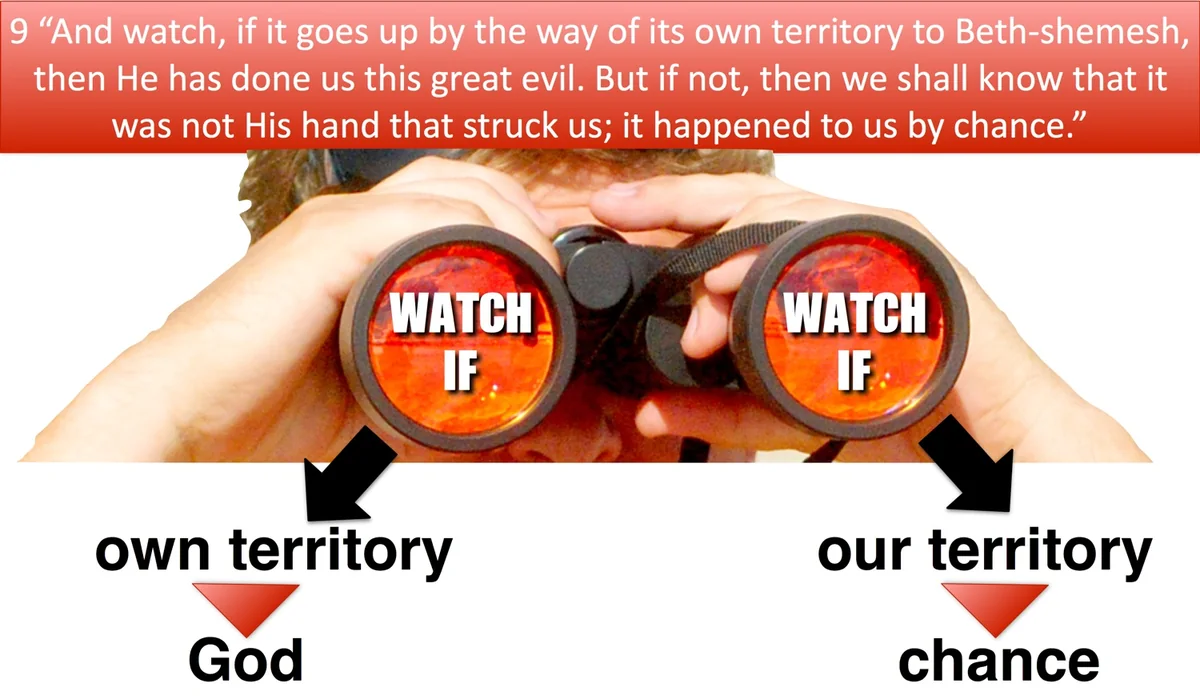
8 “And take the ark of the LORD and place it on the cart; and put the articles of gold which you return to Him as a guilt offering in a box by its side. Then send it away that it may go. 9 “And watch, if it goes up by the way of its own territory to Beth-shemesh, then He has done us this great evil. But if not, then we shall know that it was not His hand that struck us; it happened to us by chance.” 10 ¶ Then the men did so, and took two milch cows and hitched them to the cart, and shut up their calves at home. 11 And they put the ark of the LORD on the cart, and the box with the golden mice and the likenesses of their tumors. 12 And the cows took the straight way in the direction of Beth-shemesh; they went along the highway, lowing as they went, and did not turn aside to the right or to the left. And the lords of the Philistines followed them to the border of Beth-shemesh. 13 Now the people of Beth-shemesh were reaping their wheat harvest in the valley, and they raised their eyes and saw the ark and were glad to see it.
Watch if
This lesson is learned through observation. The five lords of the Philistines had good reason to follow this process because the priests told each of them to contribute a significant amount of money in solid gold pieces shaped like tumors and mice, then send it away! They were conducting an important test for themselves. It is also crucial to understand God’s interaction in the world. He did not come down and speak to the Philistines directly, but He judged them patiently. He could have wiped them off the map instantly. Instead, God allowed their slow tests, which humans are often subject to. They learned from these tests, but it was a slow process. This test cost them their gold. You can be sure that the lords were watching closely to see if the diviners were right—that was their money at stake! Even at the last minute, you can see them doubting their conclusions, as if the earlier tests were not conclusive enough. This is not necessarily a bad thing; it more likely reflects the difficulty of adapting to change.
These scenes show how eager God is for people to believe and trust Him, but also highlight our reluctance and difficulty in believing. We have the evidence in front of us, yet we still don’t believe! What will it take to truly believe?
- It is most difficult to change the way we do things, our values.
- To make it worse, we have a natural bent away from God (John 3:20)
- This third lesson would seem to convince them.
- Did it convince them? Does it convince you?
- What would it take to convince you to seek God’s truth and wisdom?
Tests are fine, but we often ignore them. Ultimately, we tend to be lazy and irresponsible. The Gospel has shown the power of God’s love over the hatred and bitterness of the world. Don't judge a professing Christian’s life, but a practicing Christian's. We see the power of Christian faith when people truly live it. Do you? Why or why not?
Conclusion
So we understand that God judged and disciplined His people. This practically meant that evil had gone so far that God permitted pain and suffering to come upon His people. God’s patience with them—and with the whole world—testifies that He does not want to judge anyone. The Lord always uses these situations strategically for His purposes. However, there is no real contest between God and man. Man challenges God’s control and disputes His wisdom, but in the end, he is either destroyed–like many of the Philistines and Israelites—or slowly and painfully learns. Men don’t see the whole picture and are convinced that their ways are better. They believe they will win, but as we learn in the Bible, what looks like a contest is really just a display of God’s glorious grace and wrath.
- God reigns - there is no real contest.
- The world stubbornly and painfully ‘learns’ through experience, but always at a great cost (foolishness).
- God’s people can learn through the truth–God’s Word (wisdom).
Final Application
- Do you believe that God is all-important and powerful? What will it take for you to believe?
- Are you still somewhat or completely captivated by secularism’s promises, even though they oppose God’s Word?
- How vital is God’s Word to your life in discovering things that will maximize your service to God and others? This message is for believers!