
Preoccupied
1 Samuel 10:17–27
Paul J. Bucknell
2. The People’s Rejection (1 Sam 10:19)
19 But you have today rejected your God, who delivers you from all your calamities and your distresses; yet you have said, ‘No, but set a king over us!’ Now therefore, present yourselves before the Lord by your tribes and by your clans” (1 Sam 10:19).
What could have been a great, glorious new beginning for Israel turned into a steep decline in their spiritual worship. They were too focused on their national pride and security to heed God’s desire to be their mighty King and guide them. That, no doubt, sounded spiritually impractical in the real world. Turning points are critical moments to make wise, godly choices, but unfortunately, they can also lead to spiritual laziness. What was the core problem?
Israel shifted from trusting in the Lord’s care to being preoccupied with managing the nation. Those involved, eager to move into their newly planned future, failed to see the change in loyalty. Sadly, this same pattern repeats itself with nations, governments, churches, corporations, families, and individuals.
Our decisions always matter!
Now, by God’s grace, we find ourselves asking the question: “It started so well. Where did it go wrong?” Have you ever asked that question? Are you asking it now? God highlights the turning point here.
A Bit of History
Instead of following God’s leadership, they insisted, “No, but set a king over us!” Why would they ask such a thing? Did they not know the ramifications of such a decision? We understand their vulnerability; it related to the lack of a clear, desirable transition. Although it seems like a one-time event, God had already discussed this with them in chapter 8. Chapter 12 acts as their final discouraging reply to God.
“And it came about when Samuel was old that he appointed his sons judges over Israel. 2 Now the name of his firstborn was Joel, and the name of his second, Abijah; they were judging in Beersheba. 3 His sons, however, did not walk in his ways, but turned aside after dishonest gain and took bribes and perverted justice.
4 Then all the elders of Israel gathered together and came to Samuel at Ramah; 5 and they said to him, “Behold, you have grown old, and your sons do not walk in your ways. Now appoint a king for us to judge us like all the nations.” 6 But the thing was displeasing in the sight of Samuel when they said, “Give us a king to judge us” (1 Sam 8:1-6)
The Israelites, disillusioned by the appointment and corruption of Samuel’s wayward sons, could not trust God to lead them forward. Samuel, the aging prophet and priest, quickly faded from the scene. They appreciated how God worked through Samuel, but he had no one to pass the baton to, like when Moses anointed Joshua.
We applaud their willingness to reject Samuel’s sons’ corruption. Sometimes, we conceal a leader’s evil; this is not right. So while they saw what they didn’t want, they had not yet learned to see or appreciate God’s plans.
Disillusionment leads to blind solutions.
This disillusionment is common among churches and groups that don’t take prayer seriously. Or, their prayers only ask God to bless their plans. Remember how convinced they were? They insisted a king would work best. People must refuse to be mesmerized by gifted individuals or chosen plans and seek God to work through godly leaders.
Three Colossal Mistakes
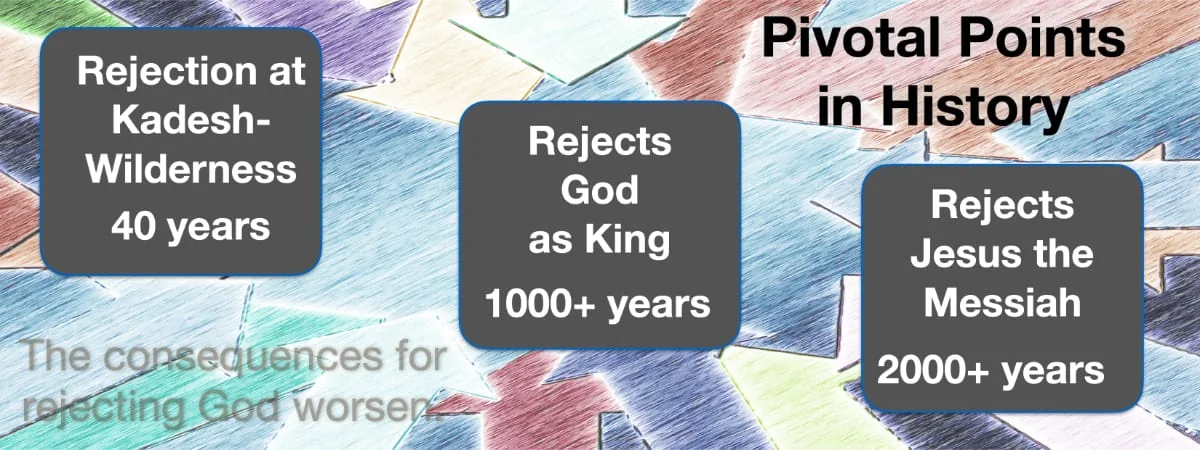
The Israelites, as a nation, made at least three major mistakes. Each time God’s people turned away from Him and His best, the worst disastrous consequences followed. I will highlight three significant ones.
(1) Rejection at Kadesh after Egypt (40 years) - Numbers 13
God powerfully delivered them from the mighty Egyptian empire. Now, on the brink of the Promised Land, God sent spies to examine its richness. But they lacked faith in conquering the land, even with God’s help. They forgot how God had just saved them from Egypt! Their lack of faith led to failure at Kadesh-Barnea, resulting in forty years of wandering in the wilderness (Num 13). God took care of them (i.e., manna), but the delay was unnecessary.
(2) Choosing a king (1000+ years) - 1 Samuel 10
God challenged them to let Him be their King, but they rejected His rule, choosing to be like the world with a physical king. Perhaps, they didn’t know the unique way that the Lord brought Samuel into the picture, or maybe they did and couldn’t be bothered with God’s arrangements.
After all, they faced real-time enemies on their land and at their borders. Samuel would soon die, leaving them without a leader. Over the next 1000 years, Israel endured many wicked kings and eventually lost their land because of their disobedience.
How often have you felt utterly discouraged by the wicked acts of the Old Testament kings?
(3) Rejecting Jesus their Messiah (2000 years+)
The last major mistake occurred when God sent His Son to offer forgiveness of sins and to strongly lead the Israelite nation. However, they lacked patience for someone who told them to love their enemies. They rejected and even killed Jesus the Messiah. The Jewish people continue to suffer the consequences to this day. The Scriptures predict a time at the very end of the ages when Israel will be humbled and finally call on the Lord for help. With all their options gone, they will cry out to God their Savior. But why not do this earlier?
God would have timely provided for them, but the severity of the consequences grew worse. By rejecting God’s solution, they rejected God Himself. They were too focused on their own solutions to consider God’s ways. God is so involved in our lives that rejecting His help is essentially rejecting Him.
Application
These uncomfortable questions lead to a central question: “Who can stand before the Lord?” It’s not that we shouldn’t approach God, but time and again, we find ourselves making wrong choices. Only later do we realize our shortcomings. Luckily, God’s mercy is vast. We can choose to leave our desperate situation by coming before the Lord, no matter where we are.