
The Big Question on King Saul’s Rejection
1 Samuel 13:8–14
Paul J. Bucknell
But I believe there are other reasons for Saul’s rejection. If we examine 1 Samuel 13-15 closely, we see that Saul fails three times, with chapter 13 being just the first. God’s rejection shouldn’t be viewed as sudden or because the Lord lacked understanding of the situation. We are presented with three examples of Saul’s failures to illustrate why God rejected King Saul.
The second failure occurs in chapter 14. Although the Lord later delivered the Israelites through Jonathan (14:23), Saul cursed everyone from eating until the enemy was defeated. Jonathan, his son and chief general, ate unknowingly but was not executed. Because of Saul’s curse, the hungry army greedily ate the food, causing everyone to sin against the Lord (14:22). Saul’s command showed an improper and harsh rule, more like man-made religion than reliance on God’s strength. Chapter 15, the third example and the most well-known, shows Saul sparing the best of the Amalekites rather than destroying them as God commanded (15:1-4). Although Saul confessed his sin in 15:24, the scriptures again state that the Lord rejected Saul from being the anointed king (15:26-29). His decisions revealed his true loyalties.
Identify Our Weaknesses
Saul clearly thought too highly of himself and was unwilling to submit to his God King. He repeatedly disobeyed the Lord’s commands. Therefore, we see that chapter 13 was not just an isolated act of ignorance or disobedience, but a reflection of a heart problem that troubled him throughout his life. Although God had helped Saul many times, Saul still chose to disobey the Lord. Once he became king, Saul achieved some success and fame but was unable to follow the Lord’s rules and instead acted like a despotic ruler. Chapter 13 spends extra time showing Saul’s confidence in himself (13:1-4), which likely stemmed from the victory over the Ammonites and the authority God had given him.
Throughout all of this, we see that the main issue is that Saul fell into the same reckless mindset as the people—placing more confidence in an earthly king than in God, the true King. This demonstrates how Saul, along with the people, rejected their true Lord. Of course, Saul should not have touched the sacrifice, and the king should not have usurped the priestly role, but the core issue is the willingness of a king and his people to follow a man rather than God. In other words, this affair was about putting trust in someone other than God the Creator, which is plain idol worship—lifting up a person in God’s seat, something more akin to the anti-Christ.
So instead of the king and people rejoicing in their God, God would remain outside of their religious facade. They could not see His provision, accept His laws as good, or love Him with all their hearts. This is why the Lord would choose another who had a heart after Him, “But now your kingdom shall not endure. The LORD has sought out for Himself a man after His own heart, and the LORD has appointed him as ruler over His people, because you have not kept what the LORD commanded you” (1 Samuel 13:14, NASB unless noted). God rejected Saul, even as He rejected Eli, and would select one rejected by others, David, a type for Jesus the King, whom the Lord would later send.
The message of this passage applies to our lives. God desires a people who find joy in Him and prioritize obedience to Him. We are here serving God in the roles He has assigned us. The main focus in life, then, is not about power or outward success, but about living a life of obedience to the Lord. Our confidence should be in God’s guidance rather than our own plans. Our calling is not to seem ‘important’ but to be genuine in the Lord’s eyes by submitting plans, roles, timing, and measures of success to God. If we can keep worldly things from interfering with our goal of pleasing the Lord, we will find true success.
Reflective Thoughts
Do your decisions reveal admiration for God or for self?
How do you celebrate success? Is it through humble prayer, praise, and service, or via parties, Facebooking, and Instagram?
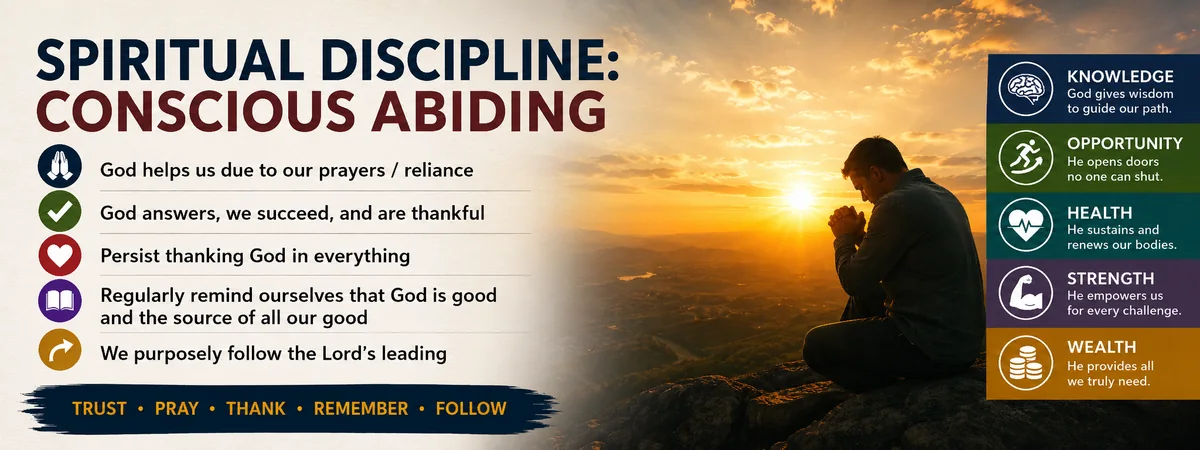
What would it take for you to develop this spiritual discipline of “Conscious Abiding”? Will you?