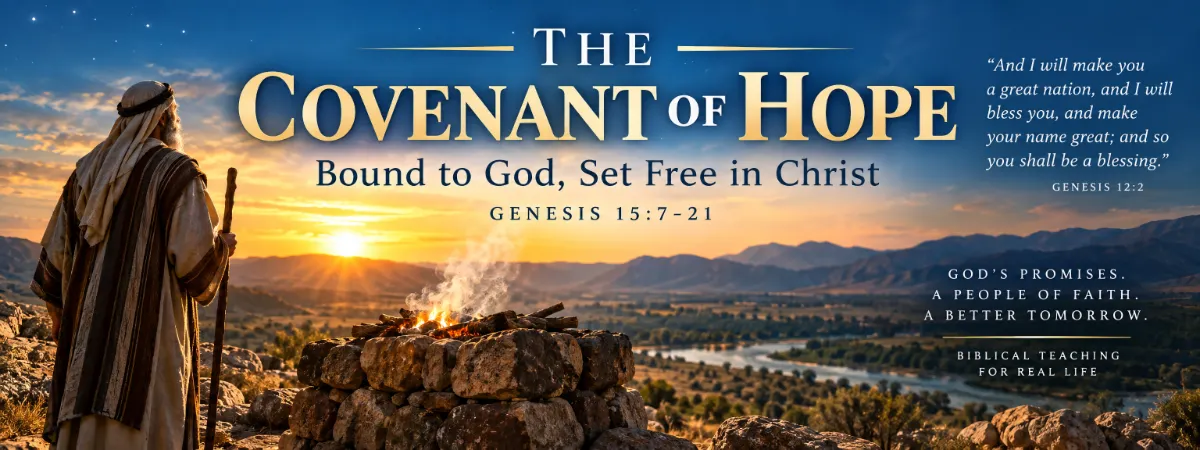
The Covenant of Hope
Genesis 15:7–21
Bound to God, Set Free in Christ
Paul J. Bucknell
A covenant-centered Bible teaching on how God binds His people to Himself through promise and faithfulness, bringing hope and genuine freedom.
Marriage is a remarkable state in which a person gives up hard-earned freedoms and commits to another in pursuit of a greater, inexpressible hope. Assets are combined, sacrifices are made, and commitments are sealed. In this surrender of freedom lies a deep opportunity to explore and discover love itself. Who can truly understand its mystical beauty? This not only reveals man's unique needs but also his aspirations.
God uses this same pattern to reveal how He draws people close to Himself. Have you ever wondered why you became a Christian? Why did you choose to surrender your right to live for yourself and instead live for God? What led you to that decision? And why don't more people become Christians if the promise is so great?
Some of the biggest problems Christians face stem from not realizing they have become part of the body of Christ and that their entire will is to please Christ. If the church is weak, it is because she is still clinging to the days when she was free to do as she pleased before meeting Christ. If the church is strong, it is because she has committed herself to living for Christ and dying to her former freedoms. God's covenant hope in Christ brings true love, hope, and freedom.
A. The Choice: Surrendering Freedom for a Greater Hope
Becoming a Christian is like getting married. We give up our own rights but gain the privilege of meeting others' needs. When someone becomes a Christian, they gain a new identity. The farther one strays from the original design of marriage, the more marriage becomes merely two people living conveniently near each other. When a person becomes a Christian, he abandons his own desires and focuses on fulfilling Christ's desires. He understands there is a greater purpose in life than his own.
What motivates a person to give up old freedoms? Hope. A person marries because he or she expects something better in the new relationship than in the old life alone. The same principle applies to the Christian. We surrender lesser freedoms because we have found a greater hope in knowing and following Christ.
God called Abraham out of his homeland, along with its gods, beliefs, practices, and behaviors. If we follow our desires instead of what is right, we are not truly free; our desires, emotions, and surroundings begin to govern us. Jesus describes a different kind of freedom: “If you abide in My word, then you are truly disciples of Mine; and you will know the truth, and the truth will make you free” (John 8:31–32).
God frees us to love others and to live according to His good ways. His path to freedom is the opposite of what the world often teaches: it includes self-denial. The world loudly proclaims freedom while remaining bound by chains of desire and lust.
When the world's promises finally prove unable to satisfy, we begin to look elsewhere for hope. Jesus says, “Blessed are the poor in spirit, for theirs is the kingdom of heaven. Blessed are those who mourn, for they shall be comforted” (Matthew 5:3–4). What Christ offers is far greater than what the world offers. Abraham leads us by his example of faith: he counted God more important than his ties to the world.
B. The Covenant: God Pledges Himself to Abram
When God plans to do something great among people, He often pledges His faithfulness to carry it out because our faith is weak. Humanity breaks promises, but God never does. A clear example is the covenant God made with Abram in Genesis 15. God bound Abraham to Himself through this solemn covenant and promised to bring great blessing to the world. We see this ultimately fulfilled in Abram's seed—Jesus Christ (Galatians 3:16)—through whom God redeemed a people for Himself.
Through this covenant, God shaped Abram's worldview. He realized he could no longer simply do what everyone else did; he had a higher calling to live according to the agreement Almighty God made with him. In Genesis 12:2, God says to Abram, “And I will make you a great nation, and I will bless you, and make your name great; and so you shall be a blessing.”
How did God do it? He did so through a covenant in which God reached out to Abram in love. As Abram trusted and followed God, God's blessings entered his life and, through him, the world. God took the initiative, bringing His undeserved grace and blessing into Abram's life and extending it to others.
Genesis 15:7–11 (NASB)
7 And He said to him, “I am the Lord who brought you out of Ur of the Chaldeans, to give you this land to possess it.” 8 He said, “O Lord God, how may I know that I will possess it?” 9 So He said to him, “Bring Me a three year old heifer, and a three year old female goat, and a three year old ram, and a turtledove, and a young pigeon.” 10 Then he brought all these to Him and cut them in two, and laid each half opposite the other; but he did not cut the birds. 11 The birds of prey came down upon the carcasses, and Abram drove them away.
1. Abram Prepares in Faith (Genesis 15:8–11)
Listening to the Lord's Directions (15:9)
It's easy to forget this part. We should always ask whether the Lord has directed us to do something, whether generally or specifically. God instructed Abram to bring a three-year-old heifer, a three-year-old female goat, a three-year-old ram, a turtledove, and a young pigeon. It cost him time and resources, and he prioritized the Lord's request.
Obeying the Lord's Directions (15:10)
After careful listening, we must obey faithfully. Abram brought the animals and, familiar with the preparations for a covenant, cut them in half except for the birds.
Waiting and Watching (15:11)
Abram then had to wait. Birds of prey came down upon the carcasses, and Abram drove them away. The verse shows Abram faithfully watching over what he had prepared as he waited for the Lord.
Genesis 15:12–16 (NASB)
12 Now when the sun was going down, a deep sleep fell upon Abram; and behold, terror and great darkness fell upon him. 13 God said to Abram, “Know for certain that your descendants will be strangers in a land that is not theirs, where they will be enslaved and oppressed four hundred years. 14 But I will also judge the nation whom they will serve, and afterward they will come out with many possessions. 15 As for you, you shall go to your fathers in peace; you will be buried at a good old age. 16 Then in the fourth generation they will return here, for the iniquity of the Amorite is not yet complete.”
2. God Reveals the Future (Genesis 15:12–16)
As the sun was going down, a deep sleep fell upon Abram, together with “terror and great darkness.” God then explained to Abram what would happen to his descendants in the future. These words would give direction, comfort, and hope during later times of suffering.
- God's people would be strangers and enslaved in another country for 400 years.
- God would judge the nation they served.
- They would come out with many possessions—a remarkable reversal after generations of slavery.
- Abram himself would die in peace at a good old age.
- In the fourth generation, his descendants would return to the land.
God explains that the sin of the Amorites had not reached its full measure and reveals God's patience with sinners, but patience without repentance eventually gives way to judgment. After another 400 years, their sins would accumulate to the point that God would bring final judgment upon them (15:16).
Abram would not personally see most of these promises fulfilled. His faith had to reach beyond his own lifetime. The promised descendants, the return to the land, and ultimately the blessing extending to the nations through Christ would unfold over many generations. The covenant therefore gave Abram hope not merely for his immediate circumstances but for God's much larger redemptive plan.
Genesis 15:17–21 (NASB)
17 It came about when the sun had set, that it was very dark, and behold, there appeared a smoking oven and a flaming torch which passed between these pieces. 18 On that day the Lord made a covenant with Abram, saying, “To your descendants I have given this land, From the river of Egypt as far as the great river, the river Euphrates: 19 the Kenite and the Kenizzite and the Kadmonite 20 and the Hittite and the Perizzite and the Rephaim 21 and the Amorite and the Canaanite and the Girgashite and the Jebusite.”
3. God Guarantees His Promise (Genesis 15:17–21)
After sunset, when it was very dark, a smoking oven and a flaming torch appeared and passed between the divided pieces. Verse 18 explains the meaning: “On that day the LORD made a covenant with Abram.” The Hebrew expression for making a covenant is literally to “cut a covenant,” which helps explain the divided animals. Scripture itself later refers to a covenant ceremony in which people passed between divided pieces (Jeremiah 34:18–20).
But Genesis 15 contains a striking difference. Abram did not pass between the pieces. God alone, represented by the smoking oven and flaming torch, passed through them.
- God made the covenant with Abraham; Abram didn't pass through the pieces. The Lord's promises did not ultimately rest on Abram's performance.
- God alone passed through the pieces, dramatically showing His faithful love and commitment to fulfill the covenant.
God used a covenant form Abram could understand, but the fulfillment rested on God's purpose and power. The Lord pledged Himself to do what He had promised.
The Israelites eventually went down to Egypt and became slaves. After the appointed generations, God led them out in the Exodus. There God established the Mosaic Covenant with Israel. Later, under Joshua, the people entered the land, and under David the kingdom was united. Across the centuries, God remained faithful to His word.
C. The Fulfillment: Our Covenant Hope in Christ
What about you and me? Has God shown us the better way? The Lord has drawn His people to Himself through the New Covenant, not made with animal pieces but with the blood of Jesus Christ. As with God's covenant with Abram, God alone planned and carried out the New Covenant. We weren't even born, yet He showed that, like Abraham, we are saved by trusting in God's saving work.
He freed us from the world's bondage and the power of our desires, and, importantly, bound us to Himself in love. We commit ourselves to live for Him, and in doing so, we are greatly blessed, enabling us to display God's love and to prioritize our Lord's preferences over our own.
What about the sacrifice? Oh yes, the Lamb of God is the unblemished “lamb” sacrificed for us. This is what God has done for us in Christ. Some don't realize why Christ died. He died so that God could establish this covenant of hope with us. Because we were lost in our sins, He offered a way out. He gave us the very best, delivering us from the world and binding us to Himself.
Jesus Christ's body was pierced, His blood was poured out, and through His sacrifice God brought us near. At His death, the great temple veil was torn in two, revealing that the way into God's presence was opened. Dare we still look back to the world and our old desires? No. Now we look only to Christ. Christ now. Christ forever.
Study and Reflection Questions
- Why is marriage a useful picture of covenant and of surrendering lesser freedoms for a greater hope?
- How does John 8:31–32 redefine true freedom?
- What did God promise Abram, and how does the New Testament connect that promise to Jesus Christ?
- What do Abram's listening, obedience, waiting, and watching teach us about faith?
- What did God reveal in Genesis 15:13–16, and why would these promises matter during later suffering?
- Why is it significant that God alone passed between the divided pieces?
- How does God's covenant with Abram help us understand covenant hope in Christ?
Related Genesis 15 study: God's Method for Growing Faith focuses on how delayed promises and long waiting became part of God's method for strengthening Abraham's faith.
Scripture quotations are from the New American Standard Bible (NASB 1995) unless otherwise indicated. New American Standard Bible ©1960, 1995, The Lockman Foundation. Used by permission.