
Abraham's Journey of Faith — Part C
Genesis 15: God's Method for Growing Faith
Paul J. Bucknell
“By faith Abraham, when he was called, obeyed by going out to a place which he was to receive for an inheritance; and he went out, not knowing where he was going. By faith he lived as an alien in the land of promise … for he was looking for the city which has foundations, whose architect and builder is God.” (Hebrews 11:8–10)
Genesis 15:1–6 — Abram Believes the Lord
After these things the word of the Lord came to Abram in a vision, saying,
“Do not fear, Abram,
I am a shield to you;
Your reward shall be very great.”2 Abram said, “O Lord God, what will You give me, since I am childless, and the heir of my house is Eliezer of Damascus?” 3 And Abram said, “Since You have given no offspring to me, one born in my house is my heir.” 4 Then behold, the word of the Lord came to him, saying, “This man will not be your heir; but one who will come forth from your own body, he shall be your heir.” 5 And He took him outside and said, “Now look toward the heavens, and count the stars, if you are able to count them.” And He said to him, “So shall your descendants be.” 6 Then he believed in the Lord; and He reckoned it to him as righteousness.
Genesis 15:1–6, NASB
The Creation of Faith
God creates situations where we might gain more faith and so be able to safely incorporate more of His grace into our lives, allowing His goodness to reach more people. Faith is crucial to this process—not only the initial faith by which we begin, but the pursuing faith by which we continue to trust Him.
God could easily have given Abraham a son immediately, but He first promised Abram many descendants while Abram still had no child. Anyone hearing of God's promise to an aging Abram might have laughed. This challenge of faith was even embedded in his name, “Abram,” meaning “exalted father.”
If people asked why Abram lived in Canaan, he could only point to what God had promised. God said this was the land He would give to his descendants, yet Abram himself lived there as a nomad. He owned almost nothing of the land he had been promised.
The promise was not fulfilled the next year. Even the birth of Isaac would only begin its fulfillment. Abram had to trust God for descendants, a land, and blessings that would unfold long after his own lifetime. Genesis 15 makes the delay explicit: his descendants would spend generations in a foreign land before returning. The long wait itself became part of God's method for developing Abraham's faith.
Abraham would face stressful times and failures, but the lesson remains clear. God repeated and clarified His promises while circumstances seemed to work against them. In this way his faith was tested and strengthened. God still uses waiting, difficulty, and apparent delay to teach His people to rely on His word rather than on what they can immediately see.
God is concerned with the increase of our faith. When He delays what He has promised, He has not forgotten His people. He is teaching us to trust the One who gives the promise.
The Fulfillment by Looking Ahead
Abraham's faith had to look far beyond what he would personally experience. He would see Isaac, but not descendants as numerous as the stars. He would live in Canaan, but not see his descendants possess the land. God's promise would continue unfolding over generations.
The promise also reached far beyond physical descendants and the land. God had said, “In you all the families of the earth will be blessed” (Genesis 12:3). The New Testament shows the larger fulfillment in Christ. Paul points to Christ as the promised seed (Galatians 3:16), and those who share Abraham's faith receive the blessing promised through him.
“For this reason it is by faith, in order that it may be in accordance with grace, so that the promise will be guaranteed to all the descendants, not only to those who are of the Law, but also to those who are of the faith of Abraham, who is the father of us all.” (Romans 4:16)
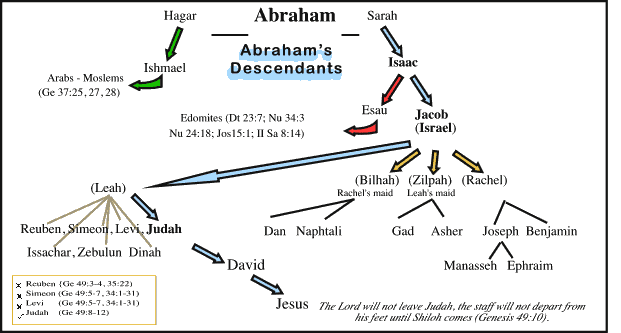
The long delay was therefore not a detour from God's promise but part of it. Abraham had to trust God for what would happen after he was gone. The diagram above helps picture how the promise unfolded through Abraham's descendants across many generations. Ultimately, the blessing promised through him would reach the nations through Jesus Christ. Faith looks forward because God's faithfulness extends beyond what we can presently see—and sometimes beyond what we will see in our lifetime.
Hebrews 11 tells us that Abraham's hope reached still farther. He was “looking for the city which has foundations, whose architect and builder is God” (Hebrews 11:10). His faith was not finally anchored in what he could possess on earth but in the God who had promised a better country.
God's method can be summarized simply: He gives His promise, teaches us to wait, strengthens our faith through testing, and faithfully brings about His purposes in His time.
Reflection
How has the Lord worked in your life? Can you identify situations He has used to increase your faith? When we better understand God's method for growing faith, we can more readily trust Him through delays and difficulties.
Related study: Genesis 15:7–21 — The Covenant of Hope examines the covenant ceremony itself, God's pledge to Abram, and the way this covenant hope points forward to Christ.