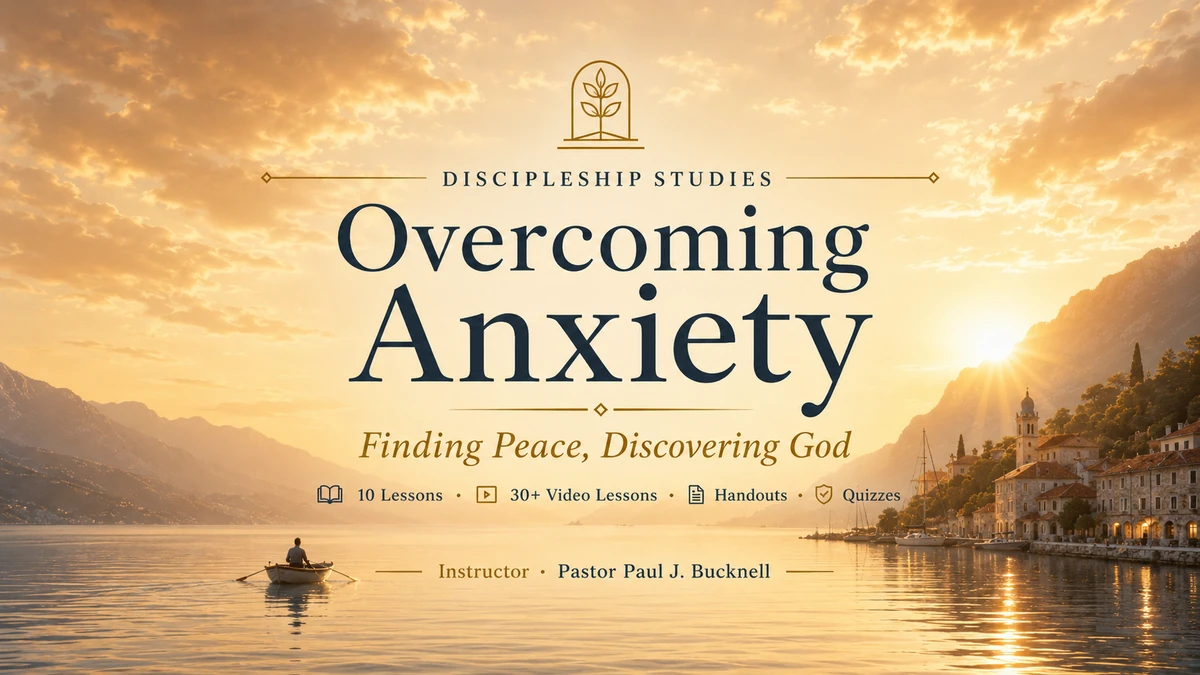
Work through ten main lessons. Each lesson groups three shorter Vimeo teachings, one complete book chapter, a combined handout, and one lesson quiz.
Enroll free to receive a private progress link and save your course work toward the certificate.
Enroll in Overcoming Anxiety
Choose email or WhatsApp. Your private progress link keeps your video, reading, quiz, final-assessment, and certificate progress together. Your enrollment message also provides the free PDF, free EPUB, and Amazon printed-book link.
Already Enrolled?
Your certificate-track progress is stored on your private progress page, not on this public page. Use the private link BFF emailed to you after email confirmation or showed you after WhatsApp enrollment.
If you lose that link, contact BFF using the same email address or WhatsApp number you enrolled with.
Course Lessons
Crossing the Bridge of Hope
Begin the journey from worry toward God’s peace by developing hope in God’s care and learning why His peace differs from the temporary peace the world offers.
Required reading: Chapter 1 — Bridge of Hope — complete chapter
Understanding Worries
Explore why people worry, how diminished trust feeds anxiety, and why understanding the roots of worry is more useful than merely covering its outward effects.
Required reading: Chapter 2 — Understanding Our Worries — complete chapter
Recognizing Responsibility
Move from explanation to personal response. This lesson focuses on owning our anxious thoughts, distinguishing concern from worry, and choosing trust instead of self-reliance.
Required reading: Chapter 3 — Recognizing Responsibility — complete chapter
Discovering Patterns of Anxiety
Learn to notice recurring anxious-thought patterns before they gain control. The lesson uses memorable pictures such as a spider web to train early detection and wiser responses.
Required reading: Chapter 4 — Discovering Patterns of Anxiety — complete chapter
Coping with Worries
Focus on what to do when anxious thoughts multiply. This lesson teaches evaluation, renewal of the mind, and replacing distorted thinking with God’s truth rather than being swept along by feelings.
Required reading: Chapter 5 — Coping with Worries — complete chapter
Destroying the Roots of Anxiety
Go beneath recurring worry to the beliefs that sustain it. The lesson emphasizes exposing lies, bringing thoughts under God’s truth, and replacing old mental strongholds with what is true.
Required reading: Chapter 6 — Destroying the Roots of Anxiety — complete chapter
Finding the Peace of God
Turn from merely resisting worry to actively dwelling in God’s peace. This lesson connects God’s promises, disciplined thinking, prayer, and the character of the God of peace.
Required reading: Chapter 7 — Finding the Peace of God — complete chapter
Handling Extreme Anxiety
Examine three levels of trust—trust in God, trust in self, and trust in nothing—and use times of crisis to expose where confidence is actually resting.
Required reading: Chapter 8 — Handling Extreme Anxiety — complete chapter
Steps to Overcome Anxiety
Bring the earlier lessons together into a repeatable response to worry. The chapter condenses the process into clear steps for affirming truth, asking God for help, and assessing the situation in faith.
Required reading: Chapter 9 — Steps to Overcoming Anxiety — complete chapter
Becoming an Overcomer
Finish the bridge journey by applying the course to difficult fears, including the fear of death, and by developing a testimony of God’s faithfulness that can strengthen others.
Required reading: Chapter 10 — Becoming an Overcomer — complete chapter
Final Assessment & Certificate Track
After all ten lessons, take the cumulative final assessment. For a certificate, complete all three videos and the assigned chapter in each lesson, pass every lesson quiz at 80% or higher, pass the final assessment at 80% or higher, and submit the completion affirmations for BFF review.
A Note About Help
This course offers biblical and spiritual teaching about worry and trust in God. Severe or persistent anxiety can also warrant support from a qualified health professional; the course is not a substitute for individualized medical or mental-health care.