Jesus, Our Intercessor · Part 2 of 3
The Reason for Mercy
Hebrews 5:1–6
Hebrews 5:1–6 explains the high priest’s representative role and shows why Jesus, God’s Son, is the sufficient High Priest appointed in the order of Melchizedek.
Watch the full sermon: Jesus, Our Intercessor
5:1 For every high priest taken from among men is appointed on behalf of men in things pertaining to God, in order to offer both gifts and sacrifices for sins; 2 he can deal gently with the ignorant and misguided, since he himself also is beset with weakness; 3 and because of it he is obligated to offer sacrifices for sins, as for the people, so also for himself. 4 And no one takes the honor to himself, but receives it when he is called by God, even as Aaron was.
5 So also Christ did not glorify Himself so as to become a high priest, but He who said to Him, “You are My Son, Today I have begotten You”; 6 just as He says also in another passage, “You are a priest forever according to the order of Melchizedek.”
This section (Heb 5:1-6) explains why God showed mercy in sending Jesus. Hence, it begins with an explanatory “for” in verse one. The Mosaic Law was wholly inadequate to cover our sins (5:1), and Christ’s greater priestly role under Melchizedek’s order makes Him wonderfully sufficient. If you are raised in a secular society, the concept of a priest may be far from your mind, but throughout history priests held a high position as mediators between the unknown world and our lives. Our moral debt, our sins, lies behind the high priest’s position and actions. He is there to offer a sacrifice on our behalf. Anyone familiar with high priests knew that the chief responsibility was to offer a sacrifice for the people’s sins.
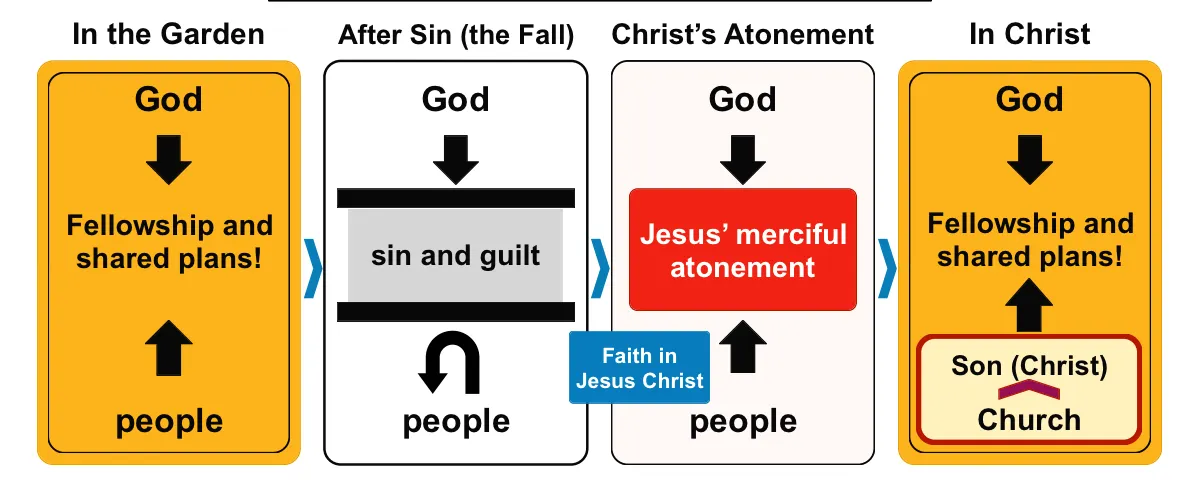
Setting aside the priest, namely the Great High Priest, is dangerous, as it exposes one to one’s sins before the Holy One. The Mosaic Law sets out numerous regulations for selecting a high priest. He was the only one able to enter the temple’s holy of holies, and only once a year, bringing the necessary sacrificial atonement. Let’s note a few things from these verses.
One essential point concerns the relationship among a priest, sacrifices, and the people. But the author of Hebrews does more than show the need for a high priest; he identifies Jesus Christ as a special, God-appointed, wholly adequate priest. In other words, don’t look elsewhere. Melchizedek will be addressed more fully in chapter 7, so we will be brief but pointed, as he is here.
The author first demonstrates Christ’s manifest greatness over others, then identifies what lures them into considering giving up their faith. Since this book is largely for Jewish believers, he reveals the inadequacies of the priesthood under the Mosaic Law and, interestingly, those of Aaron, the high priest. If we esteem God’s appointment, let us see that He has otherwise appointed Jesus Christ, His only begotten Son, as a high priest.
He first defines a high priest’s role: “appointed on behalf of men in things pertaining to God, in order to offer both gifts and sacrifices for sins.” This is helpful because many of us have never met a priest, at least knowingly. What do they do, anyway? There are many sacrifices throughout the year, but once a year, on the Day of Atonement, the designated high priest would come before the mercy seat in the inner temple and offer blood. (More on this later in Hebrews 9.) The gifts become sacrifices for the people. They bring grain or prescribed animals for sacrifice.
Second, he reveals the inadequacy of the high priest’s work. In effect, everyone depended on a sinner entering before the holy God of all creation. He fearfully enters the tabernacle’s holy of holies, the presence of God, to offer a sacrifice not only for the people but also for himself. Good, but not good enough. (See the high priest observations below.)
Third, moving to his main point about high priests, he emphasizes the importance of being appointed to this role. God appointed Aaron, the first high priest. However, the same Law also exposed his sins. Aaron made the golden calf while Moses was high on Mount Sinai before the true God. Everyone could see the glaring fragility of the system. In fact, as we learn elsewhere in Hebrews, these animal sacrifices were not what was truly needed (but that is another lesson, 9:9: “Accordingly both gifts and sacrifices are offered which cannot make the worshiper perfect in conscience.”)
But let us understand his reasoning. The Jews were thinking, “How can Jesus be a high priest if he wasn’t born a descendant of Aaron?” In fact, Jesus was not a Levite but from the tribe of Judah. “For it is evident that our Lord descended from Judah…” (Hebrews 7:14). Well, the author may sound a bit technical in the following description, but he describes two significant aspects of being a high priest: being part of a priestly order and his appointment in verses 5 and 6.
(1) Describe Jesus, the Son of God’s appointment to the greater order of Melchizedek (than Levi’s and the law).
(2) Identify Jesus’ appointment to the order of Melchizedek.
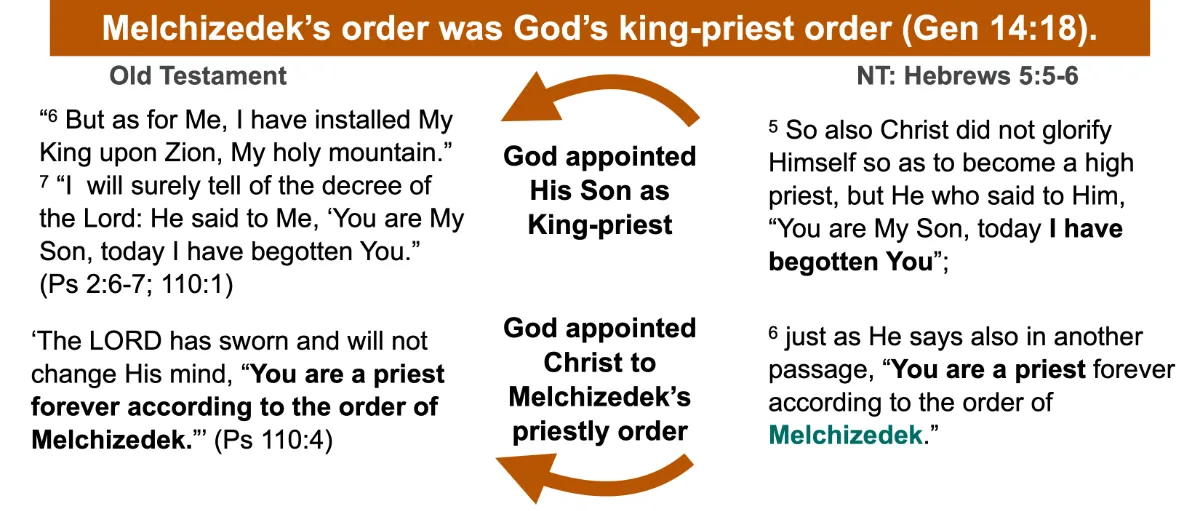
In short, Jesus was not of the tribe of Levi, but that did not matter because God appointed Jesus Christ to the order of Melchizedek. Remember, the author acts as an apologist here, defending the Gospel and strengthening Jewish believers under pressure to abandon Christ and return to Judaism. So let me briefly show his point in verses 5 and 6. As in former chapters, he points out numerous Old Testament verses (“How is it that they say the Christ is David’s son?” (Luke 20:41)). They were familiar with the Old Testament and based their attack on Jesus on the claim that Jesus was of the wrong tribe, but Jesus was of the right order, an order that preceded the Law and persists to this day.
1) Jesus is appointed (Heb 5:5)
Hebrews 5:5 quotes Psalm 2:7, with Psalm 2:6 providing the context, identifying God’s Son as the Christ, the appointed king. The Son is an obvious choice, and being begotten underscores that this is not something chosen by the Son; it is a given. You are a son; you are His Son. This connects with Psalm 2:6, which says, “But as for Me, I have installed My King upon Zion, My holy mountain,” emphasizing God’s appointment of His Son as King, as one would expect in royal families. Royal families appoint their own son to preside.
2) Jesus, the Son King, is appointed High Priest (Heb 5:6)
Hebrews 5:6 quotes Psalm 110:4. We will not get into all the details, but remember there are many specific details behind each statement. You will read of them in Exodus, Leviticus, and Deuteronomy—not all of the high priest, but many chapters are (Exodus 28–29; Leviticus 8–10, 16, 21; Numbers 17–18, 20, and 35). Let’s instead jump into the new insights into the Melchizedek order of the high priesthood, in which Jesus Christ is appointed a priest to God. There are three important points for us.
Jesus Christ is appointed high priest (5:5). When He came, the entire old order became obsolete, rendering it irrelevant. Other passages speak of the temple and the sin offerings. Verse 5 identifies Jesus as God the Father’s Son, while verse 6 quotes Psalm 110:4 to affirm His ongoing priesthood. Jesus Christ is the appointed high priest before God for all time under the order of Melchizedek (Hebrews 5:6, 10, 6:20, 7:11, 7:17).
These two factors explain God’s treatment of us as His forgiven children. They operate in the background. Consider all the other religious claims, or even those who say you need to do this and that to find forgiveness. No, Jesus Christ once for all bore our sins. Stop feeling like ‘half a Christian’ or like you need penance and must wait for forgiveness. No, nothing like that. We have one high priest, Jesus Christ, who saved us perfectly. We will see that at the end of the chapter as one of our lessons.
Jesus is human.
Jesus is perfect.
Jesus is God’s appointed High Priest.
It’s critical to recognize why the New Testament stresses Christ’s humanity. It has to do with His function as a high priest, to prove He can well represent us and bear our sin.
The Adequacy of Christ’s High Priestly Work
By restating the Law’s imperfection and insufficiency, the author of Hebrews points us to the valuable work of Jesus as High Priest. Jesus is the supreme prophet, greater than angels, Moses, and Joshua. If you think it is unimportant to follow Christ, think again. Instead, we ought to be a people perpetually indebted to such a wonderful Savior who saves to the uttermost.
We struggle to see Christ as our High Priest. We don’t share the Jewish training that centered on the once-a-year sacrifice. Questions would go through their minds:
Would the high priest do everything right? Was he good enough?
Did he have the right sacrifice? Is once a year enough? Maybe twice would be better? We have so many sins.
I don’t know the priest, but I hope somehow what he does will help me.
But there were more questions, which created doubt. After all, these animal sacrifices would not accomplish what was needed.
Scripture quotations marked NASB are from the New American Standard Bible®, Copyright © 1960, 1971, 1977, 1995 by The Lockman Foundation. All rights reserved. The Lockman Foundation.