Developing Strong Christian Lives
The Bible Teaching Commentary
Deuteronomy 8:1-20
Paul J. Bucknell
Introduction | A. Embrace | B. Understand | C. Respond | Podcast
Purpose: Deuteronomy 8:1-20 shows how we build up our faith and ward against doubt by remembering God’s good purposes even in difficult times.
A.) Embrace God’s good purposes
We strengthen our faith and ward against doubt by remembering God’s good purposes even in difficult times.
Did you notice all the purpose clauses in Deuteronomy 8?
8:1 All the commandments that I am commanding you today you shall be careful to do, that you may live and multiply, and go in and possess the land which the LORD swore to give to your forefathers.
8:2 And you shall remember all the way which the LORD your God has led you in the wilderness these forty years, that He might humble you, testing you, to know what was in your heart, whether you would keep His commandments or not.
8:3 And He humbled you and let you be hungry, and fed you with manna which you did not know, nor did your fathers know, that He might make you understand that man does not live by bread alone, but man lives by everything that proceeds out of the mouth of the LORD. 8:16 In the wilderness He fed you manna which your fathers did not know, that He might humble you and that He might test you, to do good for you in the end. 8:18 But you shall remember the LORD your God, for it is He who is giving you power to make wealth, that He may confirm His covenant which He swore to your fathers, as it is this day” (Deuteronomy 8:1-3, 16, 18).
God allows events to happen in our lives to fulfill a specific purpose. He not only gets involved in our plans when we think we need Him, but as a loving Father, He takes the initiative. If we fail to understand and accept God’s purposes, whether out of ignorance or stubbornness, we view life through a false perspective. The unbelieving world does this throughout their lives—they are unbelievers. We can understand, though sadly, that they do not know about God’s glorious grace. But what about believers? Sometimes we also doubt that God has our best interests in mind, making us more vulnerable to temptation and rebellion.
 In Deuteronomy, Moses prepares the people for the renewal of the covenant. Believers also live under a covenant. A covenant is a special plan that allows God to work powerfully in and through those who are under it. The covenant, like a will, is signed with blood—in our case, the blood of Christ. By transferring God’s wrath to Christ, His people can draw near to Him. As a result, they become bound to Him. God becomes actively involved in their lives. To develop strong Christian lives, we must understand and accept God’s involvement in our lives.
The primary goal of the Christian faith isn't just to get us to heaven, although it does, but to develop a deep relationship between God and man. Why is God so involved in our lives? Because He desires to be! He is a God we can fully trust, and if you embrace this truth, you’ll navigate life more successfully. Satan targets every believer who questions God’s love and grace. Protect yourself by trusting in God’s involvement in your life! Let’s see what this means in the following verses.
Purpose one: Reveal God’s love and grace
Deuteronomy 8:1 tells His people, “All the commandments that I am commanding you today you shall be careful to do, that you may live and multiply, and go in and possess the land which the LORD swore to give to your ancestors.” Can you see God’s goodwill here?
Live & multiply & possess
“For the LORD your God is bringing you into a good land, a land of brooks of water, of fountains and springs, flowing forth in valleys and hills; a land of wheat and barley, of vines and fig trees and pomegranates, a land of olive oil and honey; a land where you shall eat food without scarcity, in which you shall not lack anything; a land whose stones are iron, and out of whose hills you can dig copper.” (Deuteronomy 8:7-9).
What kind of life does God want for His people? A full life. Jesus expressed the same idea, “The thief comes only to steal, and kill, and destroy; I came that they might have life, and might have it abundantly” (John 10:10). God wants you to see His true purpose for these circumstances because they foster a deep trust in His ways. When we have an accident, fail a course, lose a job, miscarry, or can’t find a spouse, trusting in His loving plan is essential for a proper response. This general acknowledgment of God’s active love in our lives is a fundamental and unchangeable doctrine that strengthens our trust in Him during tough times.
Purpose two: shows how God tests His people
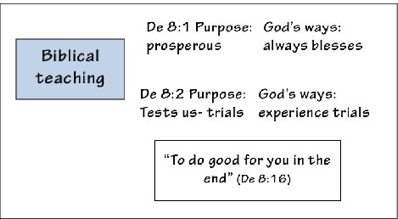
If we believe that God’s only immediate purpose with us is to prosper us, then we will end up confused. The prosperity gospel is a false gospel because of this misunderstanding. Prosperity teaching only emphasizes this one purpose as if it is the sole reason. If we think God’s only immediate purpose is to prosper us, then we might conclude that He will cause good things to happen in every aspect of our lives. While that is true, it is only true in a limited sense. We must balance this purpose with other truths about God’s overall purposes. There is more than one “that He” clause in this chapter. In the very next verse, the Lord mentions another purpose clause to balance the first.
And you shall remember all the way which the LORD your God has led you in the wilderness these forty years, that He might humble you, testing you, to know what was in your heart, whether you would keep His commandments or not (Deuteronomy 8:2).
What is His purpose here? It is quite different and unexpected from the first: “That He might humble you, testing you, to know what was in your heart...” We might interpret the first purpose as suggesting that all believers will have an easy life, but the Lord emphasizes another purpose: that He will test us. What does this ‘testing’ or trying mean?
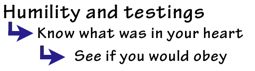 The verse says that He tests us to know ‘what was in your heart.’ Doesn’t God already know what is in our hearts? He definitely does. He knows all things. Remember how God chose David, the younger son, because his brothers’ hearts were not rightly prepared. “The Lord looks at the heart” (1 Samuel 16:7).
“For the word of God is living and active and sharper than any two-edged sword, and piercing as far as the division of soul and spirit, of both joints and marrow, and able to judge the thoughts and intentions of the heart” (Hebrews 4:12).
God uses tests for our benefit. He reveals our true strengths and weaknesses to us. Our reactions show our hearts. “So then, you will know them by their fruits” (Matthew 7:20). We can be mistaken about the state of our faith if God does not expose our weak spots. It's similar to when we get sick. The symptoms tell us we have a specific weakness in our bodies. We then turn to the Lord for help to recover, even though we may not know the exact problem.
 This exercise fosters a sense of humility before Him and helps us learn to love and trust Him more deeply. Isn't it true that after facing trials, God’s people often say, “I would not have chosen it, but God has taught me a lot through it?” What are they referring to? The tests reveal our weak faith. When our lack of trust is exposed through our poor handling of situations, we learn to trust Him more and discover more of His love and grace. The challenge is that our weakness must be exposed first, which is not easy for our pride, finances, or sense of security. But God has deeper purposes. Deuteronomy 8:16 is very similar, speaking about how He might humble us and help us understand our needs, but it continues by saying He does so “to do good for you in the end.”
In the wilderness He fed you manna which your fathers did not know, that He might humble you and that He might test you, to do good for you in the end.” (De 8:4).
Isn’t this special? We don't admit it, but everyone who has gone through tough times will find God more sweet and glorious.
Application
How does this fit into your view of life? Are you prepared to face these challenges? If you cling to worldly things, you'll see that doing so indicates you're not ready for life's tests. Your trial may seem worse than it actually is. There are reports about people feeling very insecure about their financial stability, environmental chaos, and more. Instead, we should step back and offer everything to the Lord so that when testing comes, we won't doubt His love but trust Him. He may want to test our faith and see how deep it runs.
God’s participation in our lives
God also wants us to remember how He uniquely cares for us. He is good. Points one and two are connected to this one.
8:3 And He humbled you and let you be hungry, and fed you with manna which you did not know, nor did your fathers know, that He might make you understand that man does not live by bread alone, but man lives by everything that proceeds out of the mouth of the LORD.”
God does humble His people. He humbled the Israelites in the desert, causing them to become hungry. Hunger is a very desperate need. Sometimes, however, man is so consumed with his own perspective on life that the only way to correct his waywardness is by destroying the very things he cherishes. Like me, you likely would prefer to avoid times of hunger. Yet, God has a clear purpose. We must understand this: it is so important that the Lord Jehovah is willing to break our personal piggy banks and lead our societies through chaotic times.
The Lord is intimately involved in your life.
They had a sense of independence mixed with naivety. They believed they were doing well on their own. God really didn't play a significant role in their lives. They thought He did, but it quickly became clear that they didn’t truly trust God. They only superficially believed He made and sustains the world. However, they overlooked what that practically meant. We will talk more about this later. But before moving on, let's look at one more important purpose verse in Deuteronomy 8.
But you shall remember the LORD your God, for it is He who is giving you power to make wealth, that He may confirm His covenant which He swore to your fathers, as it is this day. (Deuteronomy 8:18).
God is the ultimate source of wealth. I doubt this is covered in our economic courses, but it should be. We hope to discuss this more later, but for now, it’s clear that God wants us to understand that He is the One who gives us wealth. It’s not because we are great or clever. In this case, He did it to confirm a promise He made to their ancestors. God promised to give them the land and to provide a good land for them.
God’s purpose here goes beyond this generation of Israelites. It’s not because of them that God is making them wealthy; in a sense, they are just incidental. God is giving them these blessings because He promised their ancestors. It’s the faith of their forefathers, not their own faith. At the same time, it reminds us how important it is to have the right perspective on our lives. Sometimes, we look too narrowly and don’t consider God’s larger purposes that shape our lives (“Why did God create me?”), or we become ungrateful, forgetting the blessings that come through our parents and those around us.
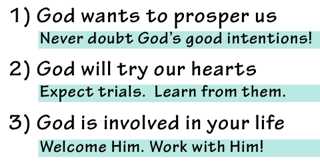 Let me summarize these three points.
1) God wants to prosper us
Never doubt God’s good intentions! We should embrace God’s good purposes. We strengthen our faith and combat doubt by recalling God’s good purposes, even during difficult times.
2) God will try our hearts
Expect trials. Learn from them. God permits these tough times to strengthen your faith so that He can bless you more, "to do good for you in the end.”
3) God is involved in your life
Welcome His involvement. Work with Him! God is involved in the details of our lives. (Deism believes in a false god.) The Creator God might have rested one day, but He is very involved in rescuing us now. Remember that it is essential to break out of secularism — the idea that God does not play an important role in caring for, providing for, and running this world. These thoughts, rooted in evolution and scattered throughout materialistic ads, deny God’s power and presence. This is the opposite of the truth; God is all-powerful and shows His love through what He provides.
__________
Let’s now understand how our life experiences fit into our spiritual growth from this study on Deuteronomy 8.