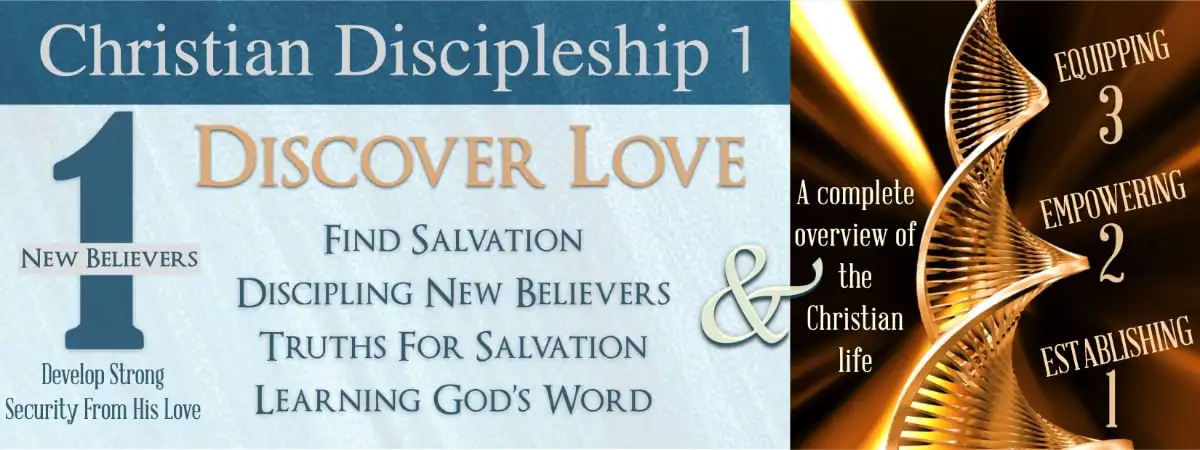
Basic Discipleship Overview
The Three Stages of Spiritual Growth & The Flow
Introduction to the Flow Diagram
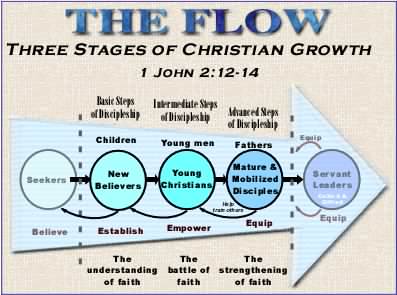
The above diagram is a smaller and partially adapted "The Flow" diagram. We have deliberately shaded out the means by which people enter this flow of life in Christ (the Seeker stage) and the end stage (the Servant Leader stage). They are important but are best discussed elsewhere.
We want to show you, through this diagram, how powerful this growth dynamic adds to your understanding of discipleship. Each of the three stages has distinctive features, as briefly discussed below. Their relationship with each other is what enables us to quickly clarify what has confused Christians for many years.
For example, we see how important discipleship is to each part of the Christian's life. We learn what each Christian should be focusing on in their lives. And perhaps most importantly, it helps us realize that Christians always need to be growing.
The FLOW has received its name from the way a river flows. The river gains momentum and carries what it has received forward. As God's people, we need to continue to be replenished day by day in Christ. The Holy Spirit helps us through each stage of the Christian life. One area is no more important than another. Each, however, has its own responsibilities and opportunities to serve.
If you would like more information, click on one of the links below. This is only a brief introduction. Other articles on discipleship are at the bottom.

- The Flow - A video podcast - Discover where you are in your spiritual life and how you and others can grow. Study guide included.
- The Flow - A set of slides with explanations.
- The Flow Explained - Biblical basis and practical application for The Flow.
The Three Stages of Discipleship
Christians are designed to grow. Whenever a Christian is stagnant, something is drastically wrong.
Each of the three stages of discipleship is developed from 1 John 2:12-14, where John uses human growth to describe the stages of spiritual growth. We could break these down further, but we are happy to retain the three categories that John utilizes: infant/child, young man, and father.
John's own words tell us that each stage has its special characteristics. Because the person is going through such a stage, he has special needs and special opportunities to grow. A child's and an adult's growth patterns will have similarities. We must not be ignorant of them. Within this general understanding of life principles, however, there are special needs of each group. We know this physically. The infant needs much to be done for her, whereas the teenager is learning to live out her life in a whole different context. This is true spiritually too.
It is urgent to formally disciple God's people. Jesus commands us to make disciples (Matthew 28:18-20). To disregard His summary of our duty, as said in this Great Commission, is utter folly. And yet, few Christians are making disciples. Once we understand the importance of discipleship, we need to start thinking of how we disciple God's people.
Most pastors think of doing this through a sermon. They are observing the general principles of life. We should all be learning during worship services. God will meet us there, but it is not sufficient. We need to formally disciple others so growth comes easily and is enjoyable without much stumbling due to ignorance and hopelessness.
The Basic Stage of Discipleship
We have written much more about these basic steps of the early Christian elsewhere. But we want to mention that it is the place where immature Christians are watched over and cared for by right teaching and modeling. My wife is planting seeds in the garden.  But we know that when the beans start growing, birds come by and snatch the top of the sprout virtually destroying the plant.
So we cover them. We also pay much more attention to watering at this stage because the topsoil dries out, and the roots haven't yet reached deep.
In the same way, we watch over a new Christian. BFF basic discipleship materials provide this type of care. By caring for their questions of assurance and providing good basic teaching about Christ and salvation, the 'infant' Christian can, in a short time of three months, grow into the Intermediate Stage of Discipleship.
The Intermediate Stage of Discipleship
This Intermediate Stage of Discipleship is also a temporary stage. We learn this through John's teaching model. No young person stays young for long. They grow up. Each young person goes through a series of physical and emotional changes that challenge their values. He wonders who he is, what he wants to do, and how he will do it. If he avoids these questions, he ends up with an adult body and an immature personality. Healthy training can bring all the growth these people need at this stage.
Growth needs to occur in many areas of his or her spiritual life. The most appropriate training really depends on where one is in their life. What do they know of God's Word? Are they married? What sins do they struggle with? Once these questions are answered, they need to start seeing how God's Word helps them grow in those areas. BFF materials are designed to foster that growth. As they grow in their knowledge of God's Word, they can overcome many former problems and become more like Christ, step by step. It is at this intermediate stage that many rough spots are taken off the Christian. As they are removed, the Christian's faith grows. The Advanced Stage of Discipleship naturally follows the Intermediate.
The Advanced Stage of Discipleship
The Advanced Stage of Discipleship is where the mature Christian is refined over a longer period of time. John compares them to the father. The father is mature. He is a leader who works with other younger ones to protect, guide, and properly care for them. These spiritual fathers have a constant need for growth. Except one will not see much of it from the outside. Their spiritual roots are growing very deep as they come to know God more.
The father is the one who bears children. The mature Christian should bear fruit. This fruit will show itself in several areas of life: more Christ-likeness, serving others to help them grow, using their spiritual gifts to equip the body of Christ, and general overseer tasks of protection against cults, leadership decisions, and helping those who need comfort. The fathers have been there. They have experienced trials and are best at comforting others. BFF has a lot of training material for those in the Advanced Stage of Discipleship. Because of a lack of clarity and challenge, many men and women drift at this stage when they should be bearing much fruit.
Summary
With this brief overview, we hope that you will explore both the many discipleship pages devoted to expanding these ideas as well as introducing free discipleship materials at all three levels, ready to be used. If you would like, explore our BFF Discipleship Training Library, which contains many articles and discipleship training series in one Place in our resource center.
Directory of Discipleship Articles
|
||
Basic Discipleship Stage
|
Intermediate Discipleship Stage
|
Advanced Discipleship Stage
|
The Plan of Discipleship (2 Timothy 2:2) |
The Heart of True Discipleship (Isaiah 50:4-7) |
|
Spirit-Dependent Teaching
|
||
Designing discipleship curriculum
|
Integrates Church Growth with discipleship
|
|
Growing the Church through Biblical Training
|
||
Discipleship Shapers
|
Understanding the Cycle of Decline and Revival (Judges 2) |
|