

 BFF is now on Facebook! Please visit and join us in releasing God's powerful Word to our generation!

God's peace can help us live above anxieties as we learn to trust in Him!






The Bible Teaching Commentary on Genesis: The Book of Foundations
Commentaries that specialize on training the teacher!

A Historical Chronology of the Book of Isaiah |


The Overview of the Book of Isaiah
The Purpose of Isaiah: Redemptive Chart of Isaiah
The Plan of Isaiah: Light & Dark Diagram
The Chonology of Isaiah
The Outline of Isaiah
Discussions of Main Sections of Isaiah (Isaiah's Cap)
Isaiah 1-6 | 7-12 | 13-23 | 24-27 | 28-33 | 34-35 | 36-39 | 40-66
Timeline for the Book of Isaiah
Judah and Assyria
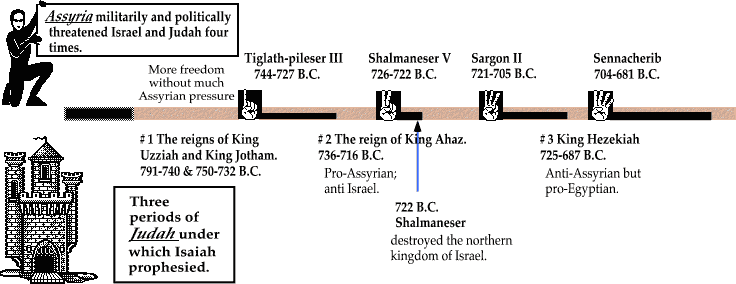
Isaiah and Judah's Chronology
(Uzziah to Hezekiah: 3 periods)
There are three distinct periods of Judah during which Isaiah prophesied. One needs to keep these in mind to understand the heart of Isaiah's message better.
"The vision of Isaiah the son of Amoz, concerning Judah and Jerusalem which he saw during the reigns of Uzziah, Jotham, Ahaz, and Hezekiah, kings of Judah." (Isaiah 1:1).

#1 Reigns of
|
#2 Reign of |
#3 Reign of |
| Judah flourished during this time.
1) Had victories over surrounding areas (nations): Edom (built Elath), Philistines, Arabians, etc. 2) Buildings: Built towers and fortifications; towers in desert; vines in mountains; Elath a seaport. 3) Troops: well organized - 307,500 men, well cared for, slinging machine. Once Assyria's Tiglath-pileser came to the throne around 745 BC, the freedom of this area gradually became threatened by Assyria. After this Uzziah sinned and was presumptuous in the temple. He got leprosy and not buried where king’s were buried. Jotham took over as co-regent at first. Jotham grew stronger and stronger because he strove to walk before Jehovah his God. He defeated the Ammonites and instituted better defenses, but the number of high places and idol worship actually increased. Towards the commencement of Jotham’s reign, hostilities with Syria and Israel began. |
This was a time of decay, open idolatry, hostilities by Syria and Israel, and a pro-Assyria foreign policy.
Ahaz was an evil king and offered his son as a burnt offering for Molech (Canaanite). He set up high places and offered sacrifices (2 Kings 16). Ahaz’ idol worship was abominable. Ahaz saw a foreign idol and requested Urijah, the priest, to build a replica of it. He placed this defiled thing right in a prominent place in the temple. The Syrians went through a part of Judah and took many captives north to Syria. This was also the time of the Syro-Ephraimic (northern kingdom) war with Judah. Rezin, the king of Syria (Aram), and Pekah, the king of Israel, went up against Jerusalem but could not conquer her (cf. Is 7:11), though they did a lot of damage. Syria took over Elath which Uzziah had conquered. Syria and Israel would have captured Jerusalem except that Ahaz, the wicked king of Judah, asked the Assyrians (Asshur) king Tiglath-pileser to help. |
His first 6 years were especially renown. Some say he ruled 725-697 BC (consistent with 2 Kings 18), and others that he ruled 715-687.
In the first year he had the temple purified and cleansed. All idols were broken apart. He reintroduced liturgical music. He even invited the defeated northern kingdom to join with them to celebrate Passover. When the people returned from the Passover celebration, they broke idols. He rebelled against Assyria and did not serve him (2 Kings 18:1ff). He defeated the Philistines as far as Gaza. Although Hezekiah got self-confident, he in the end humbled his heart. In the fourth year of King Hezekiah, Assyria came up and Shalmaneser the king of Assyria seized Samaria. At the end of 3 years, they captured Samaria (9th year of Hoshea king of Israel), and took it into exile. In the 14th year of Hezekiah, Assyria seized Judah’s cities but not Jerusalem. Hezekiah humbled himself and had a miraculous comeback. 185,000 of the Assyrians were killed by sickness (Is 37:36). They unfortunately trusted Egypt. |

Israel and Assyria's Political Struggle
Tiglath-pileser III
|
Shalmaneser V
|
Sargon II
|
Sennacherib
|
| The new King Ahaz in 736 B.C. responded to the deepening hostility from the Northern Kingdom of Israel after King Uzziah’s death by sending a large tribute to Tiglath-pileser III.
He was willing to pay the price of vassaldom to bring vast destruction upon its sister kingdom of Israel. |
King Hoshea, in Samaria the capital of Israel, resisted this vassaldom once Tiglath-pileser died.
But Assyria under Shalmaneser V commenced a siege of this city and captured it in 722. B.C. (2 Kings 6:24-29). As a result, the Northern Kingdom was no longer a separate political entity and became an internal province of the Assyrian Empire. |
Judah became associated with a revolt led by the Philistine city of Ashdod in the years 713-711 B.C. (cf. Isaiah 14:28-31; 17:14; 20:1-6).
It was probably expected that Egypt would join in this alliance against Assyria. If so, Isaiah 18:1-5 and 19:1-15 belong to this time. It is uncertain how far the rebellion spread, but Sargon II quickly stomped it out. Fortunately, Judah escaped any harsh consequences. |
Judah and Egypt formed another alliance to overthrow the Assyrians after Sargon II's death.
Sennacherib, however, brought destruction to virtually every town and fortress and city in Judah before Hezekiah was miraculously delivered (2 Kings 18-19). |


Check out our other many Old Testament articles in our newer BFF website at bffbible.org!
info@foundationsforfreedom.net
Scriptures typically quoted from the New American Standard Bible unless noted:
(C) Copyright The Lockman Foundation 1988