

 BFF is now on Facebook! Please visit and join us in releasing God's powerful Word to our generation!

God's peace can help us live above anxieties as we learn to trust in Him!




The Bible Teaching Commentary on Genesis: The Book of Foundations
Commentaries that specialize on training the teacher!
Discussions on Each Section of the Book of Isaiah |

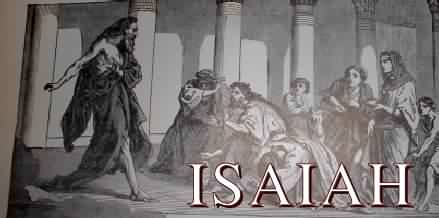
The Overview of the Book of Isaiah
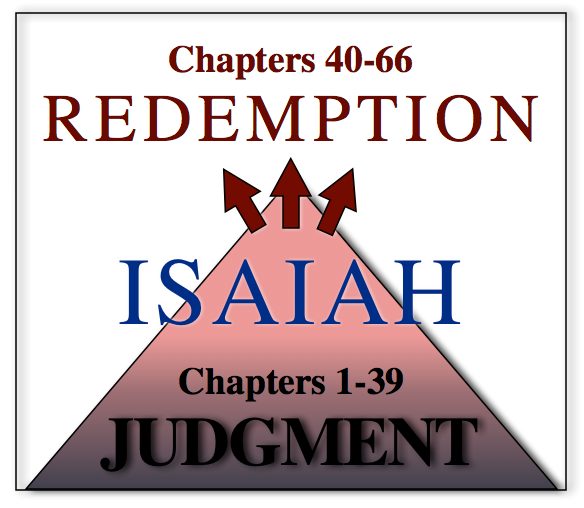
The Purpose of Isaiah: Redemptive Chart of Isaiah
The Plan of Isaiah: Light & Dark Diagram
The Chonology of Isaiah
The Outline of Isaiah
Discussions of Main Sections of Isaiah (Isaiah's Cap)
Isaiah 1-6 | 7-12 | 13-23 | 24-27 | 28-33 | 34-35 | 36-39 | 40-66
_________________________
Isaiah has two main sections:
Chapters 1- 39 (7 subsections)
Chapters 40-66 (3 subsections)
In the first 39 chapters of Isaiah, adulterous Israel is running off and making alliances with Assyria, Egypt and Babylonia. God kept calling them to trust Him, but they stubbornly resisted. God could not use His own kings to accomplish His righteous purposes. So God instead showed how He would, despite themselves, find an Israelite, a servant, who would do all of His will. This is the long promised Messiah.
 Through the first 39 chapters, the bursts of light brightening the otherwise dark scenes as they hint of the promised righteous servant.The numerous reminders of the coming destruction of the wicked humble the righteous but otherwise create hopeful hearts in God's coming kingdom.
Chapters 40-66, in clear contrast, present a string of salvation messages, with hope and utopia beautifully coloring each of them. This unexpected closing message confirms God is not so preoccupied with saving the righteous that He has forgotten the judgment of the wicked. Isaiah dashes the modernists’ approach of letting bygones be bygones. Isaiah wants the contrite to enjoy their salvation fully, but the wicked need to be warned of the impending judgment!
Click Isaiah's Cap below for a closer look at the mnemonic diagram illustrating the structure of Isaiah. Further explanations of the outline and structure are below.
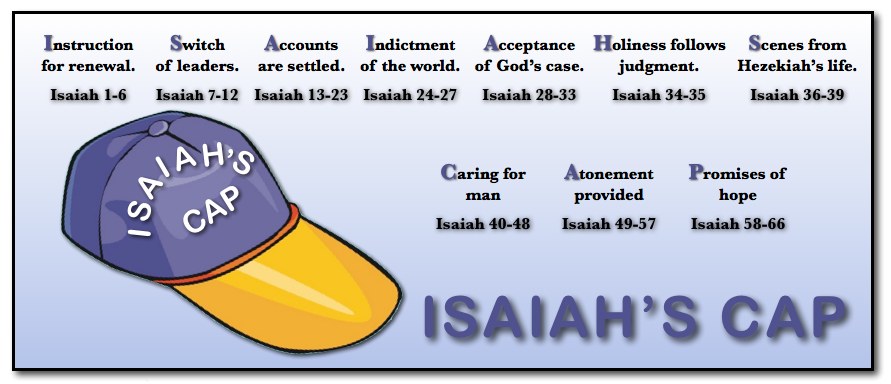
ISAIAH'S CAP: IllustrationBelow is an abbreviated discussion of each of these selections. Click for more thorough discussions.
Click image for larger picture |
||
Isaiah Chapters 1-6Instruction for renewal by Isaiah in a wicked ageIsaiah chapters 1-6 preface the massive volume of 66 chapters with a call to repentance. Although very willing to acknowledge the Israelites as His people, Yahweh sets a standard of judgment against them. They must repent from their sins or prepare for the storm of God’s wrath. And although the threats are severe, His merciful calls to return to Him are moving. An affirmative response to God’s call is exemplified by Isaiah’s humbling of heart in chapter 6. Full discussion |
||
Isaiah Chapters 7-12Switch of leaders purges evil King AhazIn chapters 7-12, we are instantly confronted with King Ahaz’s reign. These chapters are somewhat connected with the first six chapters, but the approach differs. King Ahaz’s person and response to the Lord are contrasted with Isaiah’s. God revealed Himself to King Ahaz just as to Isaiah, but the response was one of a skeptic rather than a believer. He was going to trust in Assyria to rid the northern kingdom of its threat. God counters Ahaz’s false trust by establishing His own king. Full discussion |
||
Isaiah Chapters 13-23Accounts are settled of all nations before GodClearly turning away from a single focus on the inferior rule of Israel, God turns His eye to all the nations in chapters 13-23. Each section has to do with a certain nation or capital and is set apart with the words, “the oracle of”. God undermines any trust in any nation no matter how powerful or influential. He has His own purpose for each nation. Sometimes in His mercy He chooses to work some good within that nation. Full discussion |
||
Isaiah Chapters 24-27Indictment of the world brings hope to God’s people.Chapters 24-27 crown the former chapters as they break away from the treatment of individual nations and deal with the whole world in judgment. God’s people are not to fear of the world's judgment no matter how close it comes, but they are to hope in God’s sure salvation. Full discussion |
||
Isaiah Chapters 28-33Acceptance of God’s case against His peopleIn chapters 28-33 the Lord interjects with an update on the southern kingdom’s response to God. One would hope if they didn't learn from the judgment of the other nations, they would learn from the fate of the northern kingdom, Israel. But no. Instead of trusting in Assyria, Hezekiah leans on Egypt and his supposedly innovated foreign policy. God exposes their foolish plans to trust in another besides Himself and graciously provides His redemptive plan and message. Full discussion |
||
Isaiah Chapters 34-35Holiness follows judgment as time meets eternity.Chapters 34 and 35, with their strong apocalyptic character, bring us to face two great culminating paths. The intensity of destruction characterizes the first. The beauty of God’s gracious redeeming work radiates in the second. They both are almost wholly lifted from history and time and instead portray the final scenarios for mankind. The historical names are more symbolic whether it be Edom representing the enemies of God’s people, or the usage of wilderness to paint the despairing scene around His godly ones. Full discussion |
||
Isaiah Chapters 36-39Scenes from Hezekiah’s life to understand the coming judgmentChapters 36-39 jump back into time and revolve around themes of growing hardships: war, death and the pain of pride. Isaiah is trying to bring his people to understand their situation. Judgment against Judah was certain. However, because of all the former promises, the unsettling way in which this section ends forms the basis for the following section in chapters 40-66: the humble hearts which anticipate God’s redeeming work. Full discussion |
||
Isaiah Chapters 40-48
|
||
Isaiah Chapters 49-57
|
||
Isaiah Chapters 58-66
|
||
|
info@foundationsforfreedom.net
Scriptures typically quoted from the New American Standard Bible unless noted:
(C) Copyright The Lockman Foundation 1988