

 BFF is now on Facebook! Please visit and join us in releasing God's powerful Word to our generation!

God's peace can help us live above anxieties as we learn to trust in Him!




The Bible Teaching Commentary on Genesis: The Book of Foundations
Commentaries that specialize on training the teacher!

Click for information |
Principles and Practices of Biblical Parenting– Raising Godly Children –Paul and Linda Bucknell |
Session #3
PARENTAL AUTHORITY
Purpose: Develop a scriptural perspective of the parents' responsibility to govern their children and to apply this to different aspects of life. |
A.) God's Way in the World |
.
Who is in charge of your home? Who should be?!
We often discover that the answer to these two questions is different. The parents say they are in charge, but in fact they have allowed the child to rule the home. The biggest problem, however, is not that the child has grabbed control of the family and has his parents meeting his every desire. What is worse is that the parents continue to put up with this revolt or don't know it is happening!
During this session, we will learn God's perspective of authority in the home. We will not only observe some very practical reasons why parents need to take charge of their families but the practical steps and cautions in restoring their families back to God's order. We cannot properly parent without rightly understanding and using our God-given parental authority.
A.) God's Way in the World
What is authority? Authority is the right to lead, govern or rule. Authority has been passed down by God's decree to carry out His good purposes upon earth. In particular He has given parents the authority to rule in the home for the purpose of caring for the family.
God uses authority to bring order and justice to this world. He uses three kinds of authorities to do this:
Government (Romans 13)
Judges
Parental
1) People tend to reject authority
Popular teaching has rejected authority as an excessive and abusive type of attitude and behavior that counters the goals of real love and care. Why is it that so many people believe this? There are several possible personal reasons, which help create an overreaction.
He was hurt by someone in authority.
He saw corruption or misuse of authority.
A person selfishly used his authority.
A respected person said one thing but did the other.
Take a look at our new book, Principles and Practices of Biblical Parenting: Raising Godly Children. Check out the BFF Resource Center for this book and many other helpful and relevant resources (308 pages).
Great for a Parenting Class!
Perfect for individual study!
You can purchase our parenting, marriage and other articles, handouts, videos at our store!
2) God is good!
We need to understand God's perspective of authority. Look at how God describes Himself.
"Then the LORD passed by in front of him and proclaimed, "The LORD, the LORD God, compassionate and gracious, slow to anger, and abounding in lovingkindness and truth; keeps lovingkindness for thousands, who forgives iniquity, transgression and sin;
yet He will by no means leave the guilty unpunished, visiting the iniquity of fathers on the children and on the grandchildren to the third and fourth generations." (Exodus 34:6-7)
 We see both the compassion and wrath of God in these two verses. Even if we don't understand how they blend together, we dare not separate them. This is how God revealed Himself. Distorted images of God create wrong perspectives in life including parenting.
God has demonstrated that true authority is very helpful through His creation. Sometimes we hear that the God of the Old Testament is so unloving, but this is because people have not read the Bible and seen God's great love and patience. Think for a moment. What was the world like that God made? Did it reflect His anger, severity and meanness or joy, love and abundance? The world that God made was absolutely wonderful!
 Let's look at what happened when man disobeyed the mighty Creator in the early chapters of Genesis. Did God destroy this dust-made rebel named man right away? No. In fact, we find that God chose to work patiently with man and in the end gave His only Son Jesus Christ to die for him so that he might enjoy His love, goodness and joy forever.
We are not saying that God does not express wrath. He does. He is the absolute Judge. But God goes to extra lengths to keep us from that judgment. That is love.
3) God's shows His goodness through His authority
God used His great and absolute authority to postpone judgment and bring mercy and grace. This is just what we need in our marriages and families. God has made the parents to be in authority over their children to bring them the greatest good. Let us summarize this in four points.
God is the Creator and therefore has the right and responsibility to govern or lead all of His creation including us.
We don't like to be ruled and neither do our children. This is because of our sinful inclination to self-rule so that we can satisfy our own personal desires (i.e. selfishness).
God therefore sees fit to care for His creatures by giving authority to parents to govern their own children.
Parents therefore must use their God-given authority, love and wisdom to protect and care for them.
4) Biblical teaching on parental authority
The scriptures teach about this authority that parents have over their children.
(a) Children's Responsibility
The fourth command instructs children to honor their fathers and mothers.
"Honor your father and your mother, that your days may be prolonged in the land which the LORD your God gives you (Exodus 20:12).
If we are in any doubt, the Lord repeats this injunction again and again throughout the Bible.
Children, obey your parents in the Lord, for this is right. (Ephesians 6:1).
Children, be obedient to your parents in all things, for this is well-pleasing to the Lord. (Colossians 3:2)
The word to 'honor' is the same Hebrew word that means 'to be heavy' or 'to glorify.' In other words, what the parents say is to be considered most weighty or important by the child. The command assumes the parents' authority over their children and so gives them the responsibility to provide, guide, chastise, protect and equip them for life. Practically this means that at times they need to compel the child to certain actions.
When societies are at their best, there is a lot of respect from younger people for their parents and the elderly in general. An evil age, however, is marked by disobedience. A child's defiance and despising of their parents' words reveal that the society and the children have degraded to a very low state.
But realize this, that in the last days difficult times will come. For men will be lovers of self, lovers of money, boastful, arrogant, revilers, disobedient to parents, ungrateful, unholy, (2 Timothy 3:1-2).
|

The fact is that even though a society or set of parents might tolerate this disrespect, nobody likes it. The scornful child insults others, disregards the needs of others and is arrogant. For this reason God sends judgment on people with such attitudes including children themselves.
The eye that mocks a father, and scorns a mother, the ravens of the valley will pick it out, and the young eagles will eat it. (Proverbs 30:17).
God establishes the parents' authority to carefully watch over their children so that this disrespectful attitude is not cultivated.
(b) Father's Responsibility
The father of course is responsible to rightly govern and care for his children.
"And, fathers, do not provoke your children to anger; but bring them up in the discipline and instruction of the Lord" (Ephesians 6:4).
"Just as you know how we were exhorting and encouraging and imploring each one of you as a father would his own children, so that you may walk in a manner worthy of the God who calls you into His own kingdom and glory. (1 Thessalonians 2:11-12)
Note the three things that fathers are supposed to do: exhort encourage and implore their children. A verse from Hebrews points out another important aspect of parenting.
"Furthermore, we had earthly fathers to discipline us, and we respected them; shall we not much rather be subject to the Father of spirits, and live?" (Hebrews 12:9)
Parents are to govern their sphere of responsibility (the family and home) as God would. They are not only to bring instruction and correction (discipline) but also to be patient and kind. They are responsible to do all they can to raise up godly children. Godly children by definition love God's way and serve others. They grow up to be men and women that devote themselves to God and serving others.
(c) Three summary points
1. A child is responsible to obey his or her father and mother.
2. A father is charged with exhorting, encouraging, imploring and disciplining his child.
3. A mother also has authority over the child and assists her husband in carrying out his responsibilities.
Pause for Reflection: Think through your child's words and facial expressions. Does he or she respect you? List one area that could be worked on.
B.) God's Order for the Home
God's ways are always best. We might see misconceptions and abuses of authority, but this does not mean authority  should be done away with.
Try this short experiment. Think through which families you admire and which ones you do not like.
Those parents that exercise proper authority over their children always get the winning points! To the degree that parents do not act according to their authority and responsibilities, the children become reckless, defiant and arrogant. Truly the solution is not to give up parental authority but to secure it and maintain it.1
1) The need for parental authority
The father and mother need to use their authority to shape their child. Because they gained wisdom and knowledge through their years of experience, they know what is best for the child. Their influence, instruction and correction all work together to produce a good child. They are responsible to do this.
Those parents that have rightly used their authority will rise up the world's greatest people. These children are the ones devoted to bettering others rather than themselves. They respect government and other authorities and fit into society as responsible citizens.
2) What are we training our children?
Perspectives on authority are shaped into a child very early in life. More often than not, the parents are not even aware of the training that goes on.
Let's look at an example of a father who calls his little child, but the child runs away. The father might laugh because his child acted in a cute way by running away, but if the father doesn't catch the child and make him obey, the child is actually being trained to disobey him. Indeed, this time the situation might be totally harmless, but the consequences of not dealing with the child's disobedience are multiplied. The father has taught the child that his word is not to be taken seriously. The child rejects the father's right to rule his little life.
A parent's inconsistency in enforcing the rules brings so much more disobedience and confusion into the family. When the parents disagree on how to raise the child, this inconsistency is allowed to permanently stay in the home. Or even when the parents do agree on what to do, but because of laziness or business with their own lives, they neglect the needed governing of their child.
Pause for Reflection: Do you agree with your spouse on how to raise your child? What do you do when you disagree? What should you do to solve the problem?
The earlier God's perspective is established, the easier it is for both the parent and the child. Parents need to come to agreement on how they will handle certain situations. They need to work together and act as one authority. Otherwise they will look like two authorities and the child will play one against the other to get his own way.
The parents must decide what is best and enforce what is to be done. However, we should remember that consistent pre-toddler training helps avert the challenging tests of the toddler. Consistent training of the child when he is young will help him when he gets older to conform to his parents' instruction.
Please do remember, even when we do what is right, the child still does have a sinful nature that seeks to express its own desires. We cannot completely restrain that nature from expressing itself, but surely we can constrain it.
3) Changing is not easy
If the parents have been indulging the desires of the child and not been exercising their authority over their child, then they ought to realize that there is going to be war when new standards are implemented. The conviction of the parents to live God's ways will be tested, severely at first. This is no time for the parents to give in.
Even little toddlers and infants will rebel –testing the very standards the parents have instituted. They will demand their supposed rights to tell Dad and Mom what they want and when they want it. The first days can be really terrible. I remember once when we were starting to learn these principles about spoiling our child (I forget which one). Linda was up all different times at night. She was exhausted. And yet, she couldn't but help tend to the baby's cry.
I told Linda that this was not right and decided that we would have a 'cry out' night. I volunteered to take the baby into another part of the house, and the baby and I would both camp out there. I would endure the cry. The baby didn't like it; neither did I (or Linda upstairs)! But finally the baby succumbed to her/his tiredness and fell asleep. The baby would test me again, but each time the baby's cry was shorter and less intense. Finally, within a few days, the baby slept through the full night. This serves as an example of how important it is to endure the initial protest to gain the long lasting peace of God's design.
Pause for Reflection: Are there any things that you think you ought to change but are fearful of the repercussions? Write them down along with the reasons you fear the change.
4) The Parent's Part
Here are a few things to pay attention to when implementing changes with your children. Remember that these instructions are age-related.
- Speak directly to the child; face to face.
- Make him say back to you what you said.
- Make sure you are really going to carry through on what you said.
- Don't forget to check and see if you are setting a good example.
But there are other modeling influences from the parents that greatly impact the children. We also need to help them understand how to properly relate to each other.
 C.) God's Design for Relationships
Respect for authority will take us a long way in rightly raising our children, but equally important is a close relationship with those in authority.
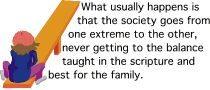
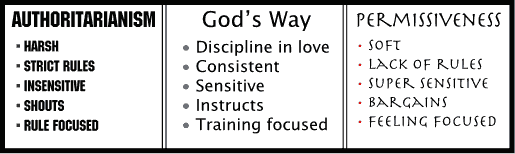
Perhaps it is easiest if we explain that there are two extremes parents use when caring for their children: authoritarianism and permissiveness, sometimes called bonding.
 |
 |
 |
AuthoritarianismThey want the law; they get the law, but it costs their child, either through bitterness (too harsh), distance (no conversation) or rejection (hypocrite). |
God's WayThey not only instruct the truth but model it. They make the truth desirable and gain a beautiful relationship with their child. |
PermissivenessThey hope for a good relationship but end up with frustration, lack of confidence, rudeness and spoiled children. |
Authoritarianism
Authoritarianism sounds excessive because it is. This kind of parent makes sure no one questions their authority. If their commands are not carried out to the letter, the parent comes down hard on the child. We see no traits of compassion, tenderness or understanding but only harshness. The parent in this case would look more like a police officer or army sergeant.
The child does 'respect' the parent and does tend to obey, but only out of fear. The problem is that it does not give a love for the instruction and builds up barriers between the child and the parent. The child will not want to talk much with that parent. Instead, resentment often builds up.
Permissiveness
This is excessive attention to the child's 'needs.' Permissiveness leads to chaos and a little 'emperor' in the home. Bonding is a word that describes the way the parent and child share the same experience and feelings. The parents that espouse this bonding perspective are convinced that giving the child what he wants, making sure he is happy, and that he never cries produces the best children. Secular philosophy convinces them that this is love.
These children have no respect for their parents. The parents have no backbone. They might instinctively know what is best for the child but will not do it. This 'soft' love will develop bitterness in the parent and child that will create a barrier between them. What was most hoped for – a good relationship – often becomes, "I'm glad they are in school so I can have a break!" The spoiled child on the other hand will begin practicing impoliteness on others and in their arrogance expect that others change their routine to satisfy their desires.
The Blend
The Lord's way is infinitely better. Christ models and teaches a combination of two important aspects of parenting: authority and love. We see this blend in Christ Jesus who was filled with both grace and truth.
And the Word became flesh, and dwelt among us, and we beheld His glory, glory as of the only begotten from the Father, full of grace and truth. (John 1:14)
Grace is graciousness in action. Grace is filled with goodness. Truth on the other hand is abrasive and strong. It is unbending. Many people react against so-called Christianity because of its absolute truths. This is unfortunate because they have never seen the truth dressed in love and grace. They haven't seen the glory of Jesus Christ.
 God uses the family to bring us into a close warm relationship with those who are in authority over us. Just a while ago, my little 3 year-old boy just climbed up on me when I was lying on the couch. I became his big pillow. We then had a couple of minutes of fun tickling and tackling.
Although I might be considered a strict father by outside standards, my children know that they can hug me, kiss me, trick me and trust me. Many have never been able to experience this close relationship with anyone in authority. God wants every child to experience both this strong unbending sense of authority blended with kindness and love.
When one receives affection from the one in authority,
fear departs leaving love and respect.
Our mighty God created the universe in Genesis chapter one. Starting in Genesis 2:4, God started using His personal name, Yahweh4, to describe Himself. He actually cultivates a close relationship with man (literally Adam). This mighty God made man in His own image that He might personally relate to him. The one who is able to speak the universe into existence in reality stoops over to talk and walk with man.
"And they (Adam and Eve) heard the sound of the LORD God walking in the garden in the cool of the day..." (Genesis 3:8).
If this isn't enough to convince us of God's desire to personally relate to us, maybe we can just think for a moment as to how God best likes to describe the relationship with His people. Christ is pictured as the bridegroom; the church is His bride.
Christ holds all power and authority, and yet He is the One who brought us close by dying on the cross. Colossians chapter 1 clearly shows us these two associated thoughts–authority and love.
"And he is before all things, and in Him all things hold together ... to have first place in everything." (Colossians 1:17-18)
"Having made peace through the blood of His cross." (Colossians 1:20)
God designed love and care to blend with a parent's authority. For this reason, I believe, there is both male and female. The husband is head exercising authority, but the wife is designed to be sensitive to the needs of the child. God has safeguarded a husband's tendency to exercise authority without love by a wife's compassion. We are not suggesting that the husband should not be compassionate or that the wife should not act out her authority as a mother over her children. Both are needed. We are only suggesting that God has brought the two as one so that they can together express the full character of God to their children as Jesus modeled in His life.
Parents need to use the power and strength of their authority to create a good relationship with those who are under their authority. Our perspectives of authority are soiled with stories of the abuse of power. We must not allow such stained images limit our ability to understand how glorious and wonderful it is to live under God's great power and love.
Pause for Reflection: What rules your home? Authoritarianism or permissiveness? What are some of the consequences of that kind of parenting in your home?
Many of us have experienced this love of God through Christ. Jesus and His death on the cross prove God's love for us and more importantly brings it right into our lives.
We love, because He first loved us. (1 John 4:19).
We will speak more on the power of love in families at a later time, but let's just quickly review how God has arranged the best modeling situation for our children.
A Balancing Act
A child will find what it needs most not by some authoritarian parent but a compassionate parent who exercises authority well. In this way the child gains both the needed wisdom and love he needs.
Trust blossoms under such conditions. If there is no love, then one only has fear. However, if one only has relationship, then there is no backbone for living. Authoritarianism or permissiveness produces lopsided children. God's love expressed through the parents produces such a lovely trust in God, care for people and a firmness about what is right and their duty to do it. The elderly Apostle John clearly refers to this.
There is no fear in love; but perfect love casts out fear, because fear involves punishment, and the one who fears is not perfected in love. (1 John 4:18)
Let's look briefly of two illustrations where this balance fails.
Government:
When the government tries to take over the family role, it ultimately fails. They provide an authority picture (even this is too distant and remote. Correction needs to be immediate). They know of law but not grace. It has no personal interest in a relationship with that child.
Working mothers
The same kind of problem occurs when the mother goes off to work. The time to develop a close relationship is never formed. A baby sitter or day care can never provide that immediate attention of correction and tenderness of love. Provision for material things never can substitute the tender love that is needed. Love must be worked out in time and relationships.
Pause for Reflection: What steps can you take to form a blended rule of authority with compassion for your home? Think about which way you tend to be. How can you come to a better balance?
Not too late!
There are some matters that need to be tended to if we have not given authority the proper place in our homes.
We should realize that it is never too late to help our children even when they are older.5 Many parents reading this might think, " I have made so many mistakes. Is it too late?" It definitely is not too late if you change now.
We need to repent before the Lord. This means that we recognize and acknowledge that our ways were not pleasing to Him and that we will now start doing what is right. We might not fully understand what the implications are, but we start by taking the first step.
Even though a parent might feel guilty about their failure, it is a terrible thing to bend the rules because they feel bad. What the child needs is consistency. They want to know we have changed. The only way to communicate this is for parent and child to live by God's standards. This produces the much-needed security in the lives of both the children and parents. Even if the child is older, the parents can begin being consistency. They need to be careful to explain their past sins and ask for forgiveness. That consistency will shake the child's old ways. This often happens when parents come to know the Lord at an older age.
Summary
Parents in many cases have allowed too much wrong to go on. They need to take back control over the home and lovingly exert their authority. A parent must go by the principles and models in God's Word rather than by their feelings. This will be harder for Mom than for Dad, so Dad needs to lead the way. Make sure the husband talks over what his plan is with his wife before he does it if at all possible! They need to communicate so they can work together.
In future sessions we will discuss how to handle particular situations. We will do our best at outlining how to restore order and relationships as they ought to be. Our confidence will be in God's Word and not in our experiences during these times.
We will not tackle everything at once. Just as our Father tenderly deals with us, we will take steps to accept God's gift of authority and exercising it. The parents will need to pray to understand God's ways for their children. Our hope is that the great goodness and love of God will be shown to our children through our lives.
Children will challenge parents who are exercising the authority that God has charged them with, but if they can combine this authority with love and compassion, then the child will really come to appreciate God's design.
I didn't know I could do that!
Parenting Principles
Authority is given from God to the parents to care for their children.
Without the parents exercising proper authority, the child's selfish tendency will grow, causing all sorts of conflict now and later.
God brings the greatest good into this world by blending authority with compassion.
The parents must follow Christ to bring the greatest good to their children.
Principles & Practices of Biblical Parenting
Family Index | Parenting Index | 中文索引頁
Goals of Parenting #1 | One Great Team #2 | Parental Authority #3 | Developing Self-control #4
Child Training #5 | Correcting Children #6 | Disciplining Children #7 | Setting Boundaries #8
Raising Godly Children #9 | Intergenerational Love #10 | Regaining Trust of Teens #11 | Integrating Truth #12
Other parenting articles: Single parenting

Index to Godly Beginnings for the Family
Or click the book to find more about purchasing!
Starting Families Right | Family Commitment | Family Planning | Husband & Wife Roles
Family Health Plan | Preparations for Childbirth
| Tender Newborn Care | Challenge of Child Training |
Disciplining & Training Small Children | Setting up Godly Routines
BFF Homepage | Top | About us | Pray for us | BFF's Approach | BFF Store | BFF RSS | Topics | OT | NT
Biblical Foundations for Freedom ( BFF )
Rev. Paul J. Bucknell
Follow @PaulJBucknell
info@foundationsforfreedom.net
Scriptures typically quoted from the New American Standard Bible unless noted:
(C) Copyright The Lockman Foundation 1988