Deuteronomy 26
The Bible Teaching Commentary
Reaching into our Hearts & Pockets
Paul J. Bucknell
Introduction (1-19) | A. Thankful (1-11) | B. Kind (12-15)| C. Be Committed (16-19) | Podcast
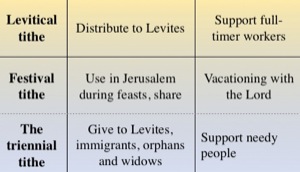
Purpose: Deuteronomy 26:12-15 helps us understand how God blesses us by regular giving. Careful attention is given to the three kinds of tithes. This is the third of four Living Commentary messages on Deuteronomy 26, encouraging us to be joyful in our giving.
B) Being Kind helps others in need (Deuteronomy 26:12-15)
"When you have finished paying all the tithe of your increase in the third year, the year of tithing, then you shall give it to the Levite, to the stranger, to the orphan and to the widow, that they may eat in your towns, and be satisfied" (Deuteronomy 26:12).
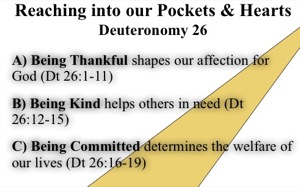 Notice that this is a three-year, triennial, tithe. It is not quite certain how the tithes fit together. The passages that speak about tithes are spread throughout the Pentateuch. Let's introduce the triennial tithe alongside the three tithes. The Lord clearly declares that the tithe is His, "Thus all the tithe of the land, of the seed of the land or of the fruit of the tree, is the LORD'S; it is holy to the LORD" (Leviticus 27:30).
#1 Levitical tithe
The first tithe is very clear. The need for this stems from the fact that the Levites did not receive an inheritance like their brothers. They only received cities with little grazing or crop land. They essentially had to depend on outside support. This worked well for them because they could focus on the tasks God had given them related to the temple and service to the people.
"And to the sons of Levi, behold, I have given all the tithe in Israel for an inheritance, in return for their service which they perform, the service of the tent of meeting" (Numbers 18:21).
The Levites then would receive a tithe from those having land and cattle.
"Moreover, you shall speak to the Levites and say to them, 'When you take from the sons of Israel the tithe which I have given you from them for your inheritance, then you shall present an offering from it to the LORD, a tithe of the tithe" (Numbers 18:26).
The Levites themselves were to tithe and give it to Aaron's line of priests.
"But Aaron and his sons offered on the altar of burnt offering and on the altar of incense, for all the work of the most holy place..." (1 Chronicles 6:49).
Application
This tithe is very much like our church tithe. We give ten percent of our earnings (and of our gifts - the Levites had to give from what they received rather than earned). This largely concerns the care for full-time church workers, such as pastors, teachers, missionaries, church planters, and evangelists, who are comparable to the Levites.
The New Testament does not speak about tithes as the Old Testament. We understand that what we do from our heart in gratefulness always should excel that which is done from law (the outward), especially when we see what God has given to us.
In the New Testament, there is the exhortation to care for those who teach. We understand this to mean those who serve, whether full-time or part-time.
"Let the elders who rule well be considered worthy of double honor, especially those who work hard at preaching and teaching. For the Scripture says, "You shall not muzzle the ox while he is threshing," and "The laborer is worthy of his wages" (1 Timothy 5:17-18).
 The point of the above verse is that the ox should be able to eat while working. In other words, while the Levite (or in our case pastor and missionary) should be cared for while involved in their work. Also see 1 Corinthians 9:6-9.
This made the Levites dependent upon the goodwill of the people and their devotion to God. If they did a good job, then they should be paid well as the people would fear God. If they did not, people would give them less. There is some sense of motivation in this setup. There is also the festival tithe. If there were ten families, their faithful tithe should be able to support one person (and family) in full-time service if there was no other overhead.
#2 The Festival Tithe (Deuteronomy 14:22-27)
This distinction of the festival tithe and the third triennial or support tithe is not clear. I am not clear why the tithe passages are not all spoken in one place or setting, rather than scattered throughout the Law (the first five books of the Bible). The triennial tithe in this passage is a good example of this scattering.
This festival tithe is calculated after the first tithe has been given. Generally, this tithe was for bringing to Jerusalem (later designated see 26:2) and for the family and others to use during their festivals. Money could be exchanged for anything, even wine or strong drink. It is not clear whether the livestock saved could be used as offerings, but the passage below does remind us that they could use it for anything.
"And you may spend the money for whatever your heart desires, for oxen, or sheep, or wine, or strong drink, or whatever your heart desires; and there you shall eat in the presence of the LORD your God and rejoice, you and your household. "Also you shall not neglect the Levite who is in your town, for he has no portion or inheritance among you" (Deuteronomy 14:26-27).
Remember that three times a year, the Jewish men had to go up to Jerusalem to worship. Having all this money and food stored up would encourage the whole family to go. It would not be an extra expense (in fact, it would save them, since they could not consume it unless they went to the feast).
This became the source of the true Israelite vacation. They were to store up food and resources for their trips to Jerusalem. When there, they could enjoy that tithe in the Lord's presence and give away part of it to the poor and Levites. Everyone was to be satisfied. What was God doing through such an order?
This law reveals its purpose as joy. They were to be joyful in the Lord's presence. God wanted them to associate their blessings of tithe with His presence. They were not to focus on their livelihood so that they would forget who provided what they had received. They were to enjoy it year after year in the Lord's presence. The evil of materialism is seen in the way that they disassociate the blessings from God and so busy in the process of storing up that they no longer are full of joy.
Notice how, during their confession before God, they are said not to eat it while mourning or grieving (26:14). God wanted them to enjoy this portion of the tithe in His presence. The lesson of being overwhelmed by God's presence was more important than their particular problems.
The world has its ways that it suggests we use our extra money. Many in Taiwan offer cars, food, and even a house (though paper ones) to the dead. Those in the West are equally devoted to the cult of self. We must not use the Lord's money for selfish pursuits but in ways that enhance our relationship with Him and care for those around us.
Truly, if we applied this to our lives, we would be happier people. We focus so much on our pursuits to gain things or on our frustrations when we don't get what we want, and we become a rather discontent group. And finally, upon retirement, when we have built up our coffers, we are too old to enjoy these things. God would rather us save some and spend this sum now each year. Meanwhile, many have left God and their families and responsibilities in pursuit of a grand future, leaving them old, ugly, and alone.
God wants us to regularly enjoy what we have received in His presence.
Application
"Let a widow be put on the list only if she is not less than sixty years old, having been the wife of one man" (1 Timothy 5:9).
We can apply this to our own lives by taking a good part of our savings, a tithe, (reflected by 9 percent (ten percent after the first tithe)) and use it in a special ministry of worship, joy in the Lord's presence and care for those around you. We see this in the New Testament with the word 'fellowship' (koinonia). In the early part of the Book of Acts, during the feasts, we would see them together taking part in these feasts and breaking the bread (having) holy communion). They would feast together in the Lord's presence and invite the poor to join them. Unfortunately, our Holy Communion services are noted for their poverty - a piece of cracker and a tiny bit of juice, inadequate for a baby.
Their problem was the opposite. They had some individuals who, through the lack of self-control, would eat and drink too much. They were only interested in the seemingly free meal.2
The church I attend has a meal after each Sunday's services. For many years, it was free. The poor would join us (sometimes only for the meal, which was okay), and others who had little could eat with us. Even now, the charge is minimal. Perhaps included in this tithe would be the costs of a building or meeting place if the numbers assembling would warrant it.
Where tithes were compulsory for the Old Testament believer, it is good for the believer under the New Covenant to voluntarily and cheerfully give.
"Let each one do just as he has purposed in his heart; not grudgingly or under compulsion; for God loves a cheerful giver" (2 Corinthians 9:7).
Think of this as your freewill offering. Many a time, we are so focused on getting a car or house that we will put off our regular giving until we obtain those things (which tends to never end). This is sin. We need to be a people noted by our giving. I have found it easier to set aside a sum of money in an imaginary or real fund that I must spend every year, whether for the poor, a missionary, a special gift, hospitality, etc. In other words, I am looking for an opportunity to give.
This becomes one of my annual goals. I am looking how to give it. It can be through the church, but not necessarily so. It might be a neighbor, needy friend, helping those settling in, reaching out to refugees, caring for orphans in another country, etc. It is a lot easier when I am looking to give $100-$300 away each month, rather than feeling burdened when I hear of a certain need.
It was through this kind of beneficent giving that Christians have started schools, hospitals, orphanages, and other places of care throughout the world. We see this care given in India. The Hindus believe it is because Christians bribe the Hindus to become Christians. In fact, we are caring for individuals. We help believers in their needs and sometimes unbelievers, too. We care about everyone. These gifts become a special goal in our lives and upon which the Lord will gauge our love for Him.
Children should learn to give from what they receive. Everyone on earth should give to the Lord. They have all received of the Lord and we should give back to Him in order to reflect His glory.
#3 Triennial Tithe (Deuteronomy 26:12)
Some people think that this tithe is a separate tithe, while others believe it is part of the second. The reason for the latter is that the purpose of the tithe is very similar.
"When you have finished paying all the tithe of your increase in the third year, the year of tithing, then you shall give it to the Levite, to the stranger, to the orphan and to the widow, that they may eat in your towns, and be satisfied" (Deuteronomy 26:12).
The triennial tithe was given every three years. The unclear part is whether they were to examine their giving every three years and give a proper tithe or that it was a separate tithe. 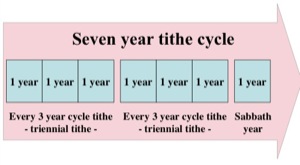 The thought is that every three years one would be able to fully calculate the tithe, seeing that the crops and needs differed every year.
Sometimes a crop is low. Less can be given in a year, but then the next year the harvest would be bountiful. At the end of three years, they need to make sure the three years' worth of tithe is fully in. In the diagram, we see that this would fit into their seven-year cycle by having two three-year cycles (see diagram). On the sabbath year they would not sow or harvest and give the ground rest.
After three years, one needs to make sure that they have fully given what they should have given. This is the context of what we see here in Deuteronomy 26. Whether it is a separate tithe or not does not matter much to us, as it is not a specific tithe we should give. We should dedicate ourselves to giving. Each year we should increase our giving and thus please the Lord. This tithe, however, does focus on the Levite, the stranger, the orphan and the widow. Some purposes are similar to the Festival tithe and so some think that on the third year it should only be rightly calculated and given.
Application
The question for us is that if the Israelites were expected to give upwards of twenty to thirty percent of what they get, what shall we do under the freedom of the New Covenant? Our giving conveys a powerful message to the world: hospitality, a source for micro-loans for the poor (investment without repayment)), local and foreign missions, struggling families, etc.
God gave His best in Jesus. Do we take the best to do the best? Jesus took His life and invested it in the lives of others. How do we handle our time? Are we joyful givers? Do we steal, erroneously thinking that we can profit from not giving? Every three years the Israelites would need to make a confession before the Lord about their giving.
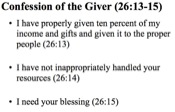
Confession of Giver (Deuteronomy 26:13-15)
This confession is very touching. Because it is a prescribed confession, either one will say it because it is true or lie. This clarifies the importance of this duty, especially when one says it in front of God.
(a) I have properly tithed the amount and given it to the proper people (26:13)
"And you shall say before the LORD your God, 'I have removed the sacred portion from my house, and also have given it to the Levite and the alien, the orphan and the widow, according to all Thy commandments which Thou hast commanded me; I have not transgressed or forgotten any of Thy commandments" (Deuteronomy 26:13).
Either you have or have not carried out God's commandments. This is the way the Law is. You might not like to admit to your faults, but this confession does not allow for "I have given 70% of what I should." This provides a powerful incentive to properly give and to make sure it got to the people it should.
(b) I have not inappropriately handled the gifts (26:14)
"I have not eaten of it while mourning, nor have I removed any of it while I was unclean, nor offered any of it to the dead. I have listened to the voice of the LORD my God; I have done according to all that Thou hast commanded me" (Deuteronomy 26:14).
 There are some who mishandle their gifts. It is appropriate that we care for animals, but some of us have lifted up the lives of animals over the lives of people.
I read of one missionary going by a half-dressed, unconscious woman on the road in Africa. She stopped and moved her to the side, covered her and bought her something to drink and eat. Many others passed by this half-naked epileptic woman. They placed no value on this needy woman. There are many needy people we need to help, not eliminate, because we fear the earth cannot hold them all.
We should kindly care for animals, trees, and the air, but it is very important to care for people made in God's image. This remains a priority. The culture and values around us so strongly surround us that we often cannot see how they displace or distort God's values. God's people are to carry out His values.
(c) I need your blessing (26:15)
"Look down from Thy holy habitation, from heaven, and bless Thy people Israel, and the ground which Thou hast given us, a land flowing with milk and honey, as Thou didst swear to our fathers" (Deuteronomy 26:15).
A real change in attitude and behavior will only come about as we begin to desire God's blessing more than money or harvest. We should crave God's blessing because it is the best that God has in store for us His people. This blessing differs for each believer. Each of us has our own contexts within which to live. We will be judged according to them.
If we believe His blessing is most important, then we will give as appropriate for His blessing is contingent upon our giving. God wants us to have a whole new attitude and this is reflected in the third section of Deuteronomy 26.
Next -> Being Committed determines the welfare of our lives (Dt 26:16-19)
BFF Articles to Deuteronomy
Deuteronomy Introduction: Outline, index, Overview
Deuteronomy 2-3 Gaining Perpspective
Deuteronomy 5:1-23 Knowing God
Deuteronomy 5:1-5 Our Gracious Calling
Deuteronomy 5:6-21 Our Loving Standard
Deuteronomy 5:22-23 Our Special Relationship
Deuteronomy 8:1-20 Developing Strong Christian Lives 1 2 3 Podcast
Deuteronomy 21:15-21 Reformation 1 2 3 | Podcast | ppt | pdf Podcast
Deuteronomy 22:5 Gender Culture Sins
Deuteronomy26:1-19 Reaching into our Hearts and Pockets | Podcast
_________
Check for more resources on the OT & NT BFF Biblical Training Library!