
Reformation
Bringing long-lasting godly changes
to our society
The Bible Teaching Commentary
________________________
Parental Love
How should one handle inheritances in a dysfunctional family?
Deuteronomy 21:15-18
Paul J. Bucknell
Reformation | Dt 21:15-17 | Dt 21:18-21 | Podcast
Purpose: Deuteronomy 21:15-17's Parental love is the second of three Living Commentary's messages that reveal how God's compassion and justice is seen in the way He shapes the Israelite society by rightly passing on inheritances.
Introduction to Deuteronomy 21:15-21
We should not be afraid of any Bible passage. We might run into passages we do not understand or do not apply to our lives, but do not be afraid. Since the Lord spoke them, He can, in His good time, speak to us through them. God has singled out these things in order to keep His people pure. The Lord was writing a complete law for the society. This is quite different than setting forth principles of life. Behind each of these laws, however, we can see what God is protecting, valuing, and preserving as well as what He hates, devalues, and sets out to destroy.
Deuteronomy 21:15-21 discusses two areas of concern.
- Parental love (Deuteronomy 21:15-17)
- Rebellious children (Deuteronomy 21:18-21)
Both of these things have to do with parental responsibilities, but are given in the context of societal concerns. Each addresses a problem that we still find in society today, along with what is to be done about it. In contrast to the laws today, they are very brief.
As in most laws, explanations for the laws are not given. In this case, God determines the sentence for each violation. God uses His values to shape Israelite behavior in the areas He considers most important. We must keep in mind that the Lord has highlighted these areas of need while not mentioning many others. When we live the way God is pleased with, then God brings His blessings into our midst. Laws preserve these values as much as possible.
So let's look at the first area of concern.
1) Parental love (Deut. 21:15-17)
"15 If a man has two wives, the one loved and the other unloved, and both the loved and the unloved have borne him sons, if the first-born son belongs to the unloved, 16 then it shall be in the day he wills what he has to his sons, he cannot make the son of the loved the first-born before the son of the unloved, who is the first-born. 17 But he shall acknowledge the first-born, the son of the unloved, by giving him a double portion of all that he has, for he is the beginning of his strength; to him belongs the right of the first-born" (Deuteronomy 21:15-17, NASB).
Observations of Deuteronomy 21:15-17
The scriptures do not say many things about parental love. A parent in most cases has a special concern for his or her child. The scriptures teach parents to instruct their children in the way of the Lord (Deuteronomy 6:1-9). Parents are to consistently discipline their children (Hebrews 12:4-14).
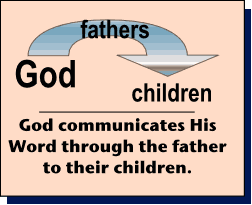 The father is not to provoke the child to anger (Ephesians 6:4). From the other perspective, there are many exhortations given to children on obeying their parents (e.g. Ephesians 6:2-3; Deuteronomy 5:16).
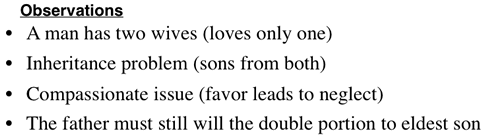
Here in Deuteronomy, however, pops up a law that identifies a hopefully rare situation. In this specific case the man has two wives, one loved and the other not loved. (Study Jacob's problem here). He has children through both of them. The problem has to do with how much inheritance he will give the sons from the loved wife and the sons of the unloved wife.
We know what the problem is, do we not? What is the temptation? The temptation is to give much if not all of his inheritance to his sons of the wife he loves. In Hebrew society, several factors determined what should be done. The oldest son typically gets a double portion. He would also be responsible to care for his widowed mother.
All societies are different. Our society has no rule requiring the older son to receive a double portion. That is up to the parents. In fact, it is common for the wife to inherit the property and later distribute the inheritance. In the Hebrew culture back then, property and their livelihood went from father to sons. The sons would then care for the family. When we speak of reformation, I am not suggesting that we return to ancient Hebrew culture. We do, however, need to pay attention to the abuse that God prevents through these laws.
God's concern
If the father, either because of his bitterness from his first marriage or through focus on his new wife's family, passed all or most of the inheritance over to the sons of the wife that he loves, then this possibly would leave the other wife and children instant beggars. We could even guess, knowing man's hardness of heart, that he would not even mention his first wife and family. In this case, the son of the loved wife would ask the other wife and children to move out. He would not feel obligated to care for them.
Let us make a few observations about the law on society.
- The law takes into consideration the wicked heart of man. Man at times acts compassionless.
- The law forces man to do what he should do even if he does not feel like it.
- This law forces the father to give twice the portion to the oldest son even if he is from his estranged wife. This is the right of the firstborn.
Summary
The heart of the law protects and preserves the weak. It reflects God's compassion. God thinks about the problems that would develop without this law and so communicates it to man. He shapes man's decision through this law. He recognizes that without such laws, men might make selfish and painful decisions. It might be legal but not right.
God wanted to preserve the culture because it preserved the welfare of the mother and children. It had not to do with what one felt. By keeping the tradition, the society would be best protected.
If a law did not settle this dispute, then one could foresee perpetual fights between the family members. Half-brothers would not associate with each other. A half-sister would not help the other half-sister. Money wrongly handled can be used by the evil one to instigate family infighting and poverty. Or, as in our deteriorated culture, we could see children born through women who were not even their wives. This law helped assure order and justice despite many bitter hearts.
Our Concern
Providing double to the older son ensured that the most stable and conscious son would care for the land. This was his responsibility. Back then, the homestead, the ranch, farm, or vineyard was how the property was cared for. As the oldest son, he would learn responsibility for all the other siblings early on. God, I believe, was concerned that the family be wisely provided for. 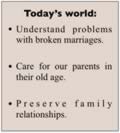 He was especially concerned for widows who had no other means of support. This law ensured that his former wife would be cared for.
Although our cultures are so different today, we need to make sure , as a father, that our wives are cared for by rightly dividing the inheritance. Nowadays, this can be done by leaving everything to the wife. Women can own property. Of course, if there were two wives, or no other wife or a disliked wife, as is so common in our world, the husband might give all he has to a girlfriend and not leave his wealth to his children so they can help care for his former wife.
Hatred can be mean. This is the time meanness needs to be curbed. I know of no laws to prevent abuses. In former years, we had cultural protocol. A man would only have one wife and would stay with her. Today's family landscape has greatly changed. And so husband and wife have their own jobs, bank accounts and lives. In a world filled with separations and divorce, where forgiveness and compassion are not actively taking place, there needs to be laws, or there will be serious injustice.
Social Security, the retirement fund, seems to function on the older model of society, where there was one spouse. I am not sure whether it is updated, or whether one can change the amount the spouse should receive. Many legal cases involve the amount husbands should pay their wives for child care. Unfortunately, many husbands get away with not paying these alimonies.
I suggest loving your husband or wife. Forgive her. If your father or mother faces difficulties, we, as children, should make sure they are provided for to the best of our ability. Give them an alternative to live with you. Perhaps many grown-up children need to start loving their parents so that they can properly care for them in their later years. I do not think that distant rest homes generally please God. The bodies of our aged parents might be cared for but not their souls. Remember, compassion not only reaches into our pockets but also into our hearts.
It is for this purpose that I set out on one or more thousand-mile+ journeys each year to visit my parents. It is one large need in my life. Society says I do not need to care for them. They choose to live far away. I do my best to love them. I want to preserve the relationship and give of what God has given me to help them as needed.
Our object in this message is first to help you see this connection between the blessings of life and God's presence, but also to show you how this specifically works out in our passage. God's presence is preserved and His blessing is secured by living in a way that honors Him. We need to obey Him.